The Moon
The Moon is Earth’s only natural satellite—a rocky, cratered body about one‑quarter the diameter of Earth, orbiting at an average distance of approximately 384,400 km. It influences tides, stabilizes Earth’s axial tilt, and was formed about 4.5 billion years ago following a collision between Earth and a Mars-sized object.
Source: science.nasa.gov
APODs including "The Moon"
Eclipse under the Bamboo
26/06/2020
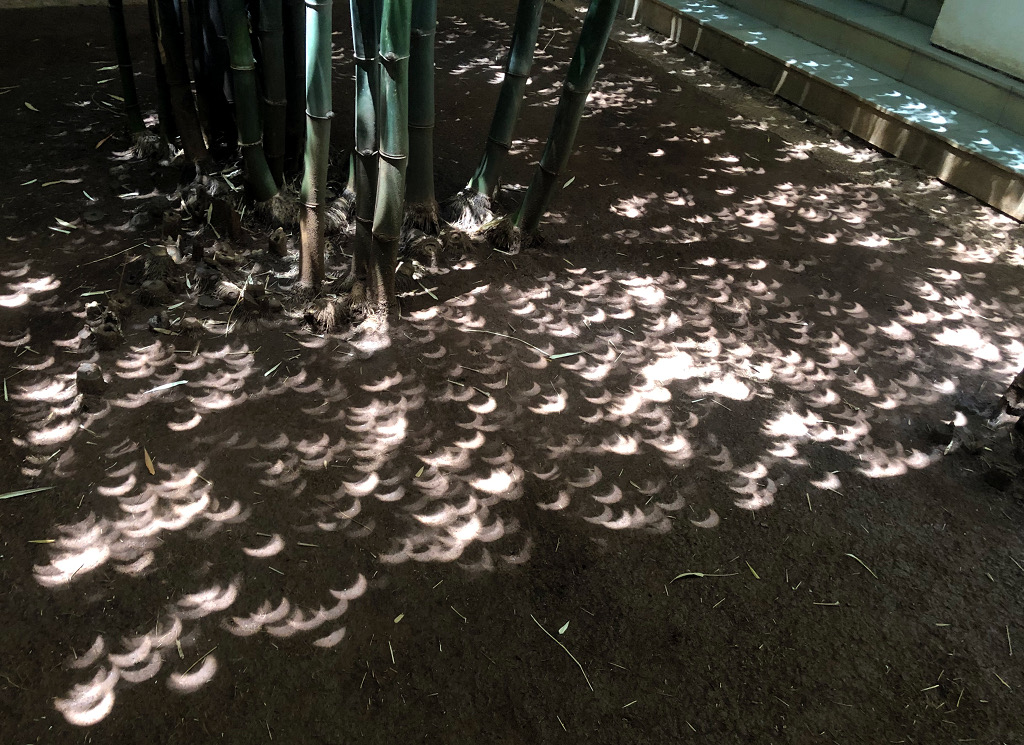
Want to watch a solar eclipse safely? Try looking down instead of up, though you might discover you have a plethora of images to choose from. For example, during the June 21st solar eclipse this confusing display appeared under a shady bamboo grove in Pune, India. Small gaps between close knit leaves on the tall plants effectively created a network of randomly placed pinholes. Each one projected a separate image of the eclipsed Sun. The snapshot was taken close to the time of maximum eclipse in Pune when the Moon covered about 60 percent of the Sun's diameter. But an annular eclipse, the Moon in silhouette completely surrounded by a bright solar disk at maximum, could be seen along a narrow path where the Moon's dark shadow crossed central Africa, south Asia, and China. Gallery: Notable images of the Annular Solar Eclipse of 2020 June submitted to APOD