The Moon
The Moon is Earth’s only natural satellite—a rocky, cratered body about one‑quarter the diameter of Earth, orbiting at an average distance of approximately 384,400 km. It influences tides, stabilizes Earth’s axial tilt, and was formed about 4.5 billion years ago following a collision between Earth and a Mars-sized object.
Source: science.nasa.gov
APODs including "The Moon"
The Reappearance of Mars
11/09/2020
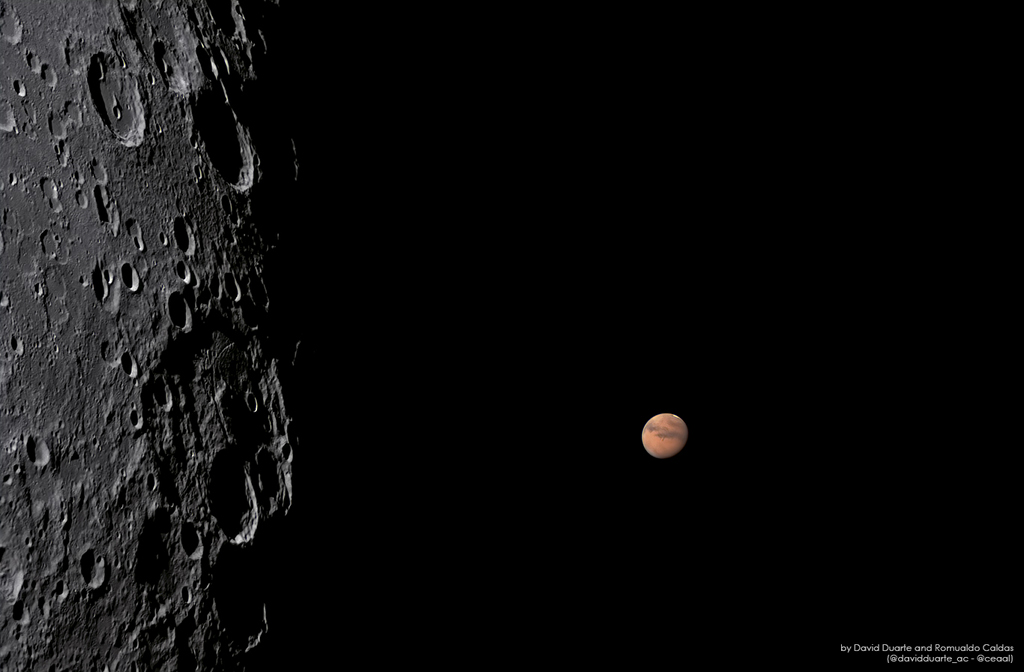
Mars reappears just beyond the Moon's dark limb in this stack of sharp video frames captured on September 6. Of course to reappear it had to disappear in the first place. It did that over an hour earlier when the sunlit southern edge of the waning gibbous Moon passed in front of the Red Planet as seen from Maceio, Brazil. The lunar occultation came as the Moon was near apogee, about 400,000 kilometers away. Mars was almost 180 times more distant. It was the fourth lunar occultation of Mars visible from planet Earth in 2020. Visible from some southern latitudes, the fifth lunar occultation of Mars in 2020 will take place on October 3 when the Moon and Mars are both nearly opposite the Sun in planet Earth's sky.