The Moon
The Moon is Earth’s only natural satellite—a rocky, cratered body about one‑quarter the diameter of Earth, orbiting at an average distance of approximately 384,400 km. It influences tides, stabilizes Earth’s axial tilt, and was formed about 4.5 billion years ago following a collision between Earth and a Mars-sized object.
Source: science.nasa.gov
APODs including "The Moon"
Moon Pairs and the Synodic Month
26/09/2020
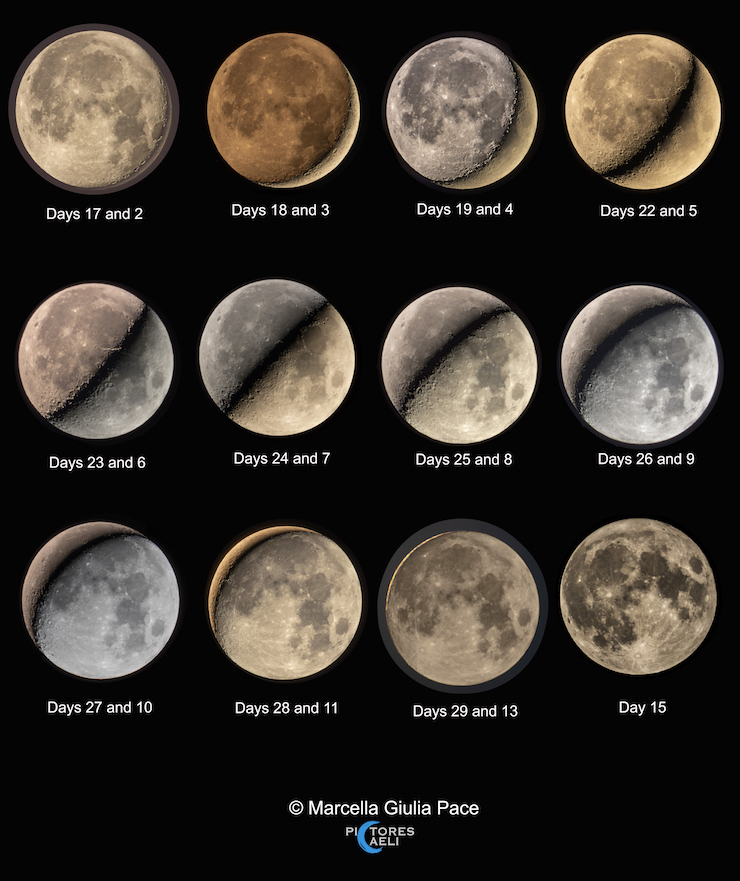
Observe the Moon each night and its visible sunlit portion will gradually change. In phases progressing from New Moon to Full Moon to New Moon again, a lunar cycle or synodic month is completed in about 29.5 days. They look full, but top left to bottom right these panels do show the range of lunar phases for a complete synodic month during August 2019 from Ragusa, Sicily, Italy, planet Earth. For this lunar cycle project the panels organize images of the lunar phases in pairs. Each individual image is paired with another image separated by about 15 days, or approximately half a synodic month. As a result the opposite sunlit portions complete the lunar disk and the shadow line at the boundary of lunar night and day, the terminator, steadily marches across the Moon's familiar nearside. For extra credit, what lunar phase would you pair with the Moon tonight?