The Moon
The Moon is Earth’s only natural satellite—a rocky, cratered body about one‑quarter the diameter of Earth, orbiting at an average distance of approximately 384,400 km. It influences tides, stabilizes Earth’s axial tilt, and was formed about 4.5 billion years ago following a collision between Earth and a Mars-sized object.
Source: science.nasa.gov
APODs including "The Moon"
Trail of the Returner
31/12/2020
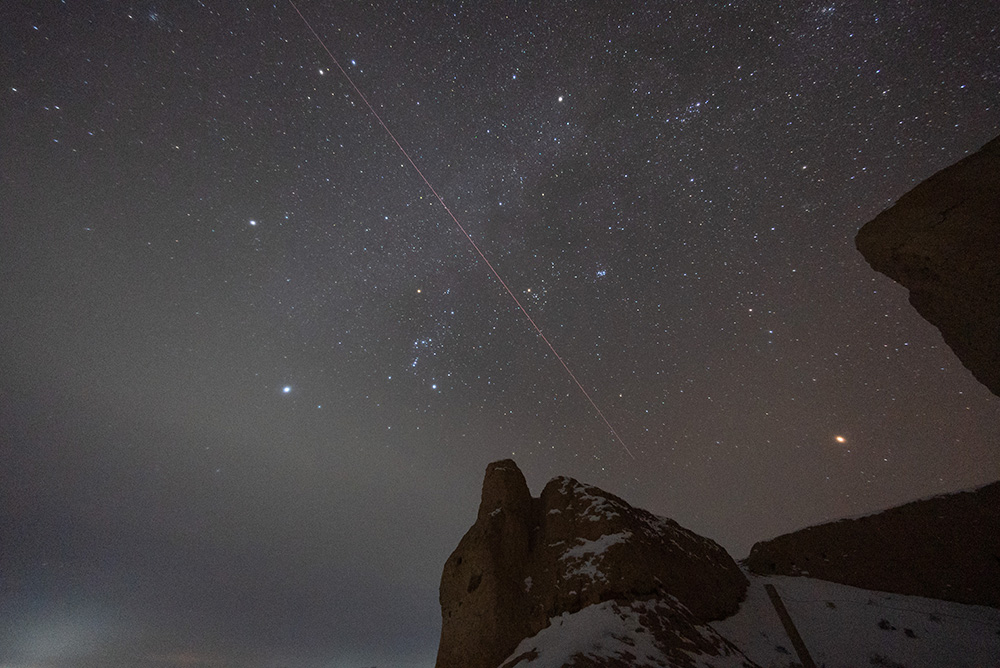
Familiar stars of a northern winter's night shine in this night skyview, taken near Zhangye, Gansu, China and the border with Inner Mongolia. During the early hours of December 17 Orion is near center in the single exposure that captures a fireball streaking across the sky, almost as bright as yellowish Mars shining on the right. Splitting Gemini's twin bright stars Castor and Pollux near the top of the frame, the fireball's trail and timing are consistent with the second skipping atmospheric entry of the Chang'e 5 mission's returner capsule. The returner capsule was successfully recovered after landing in Inner Mongolia, planet Earth with about 2 kilograms of lunar material on board. The lunar sample is thought to contain relatively young material collected near the Mons Rumker region of the Moon's Oceanus Procellarum. Launched on November 23 UT, China's Chang'e 5 mission is the first lunar sample return mission since the Soviet Union’s Luna 24 mission in 1976.