The Moon
The Moon is Earth’s only natural satellite—a rocky, cratered body about one‑quarter the diameter of Earth, orbiting at an average distance of approximately 384,400 km. It influences tides, stabilizes Earth’s axial tilt, and was formed about 4.5 billion years ago following a collision between Earth and a Mars-sized object.
Source: science.nasa.gov
APODs including "The Moon"
Mid-Eclipse and Milky Way
27/05/2021
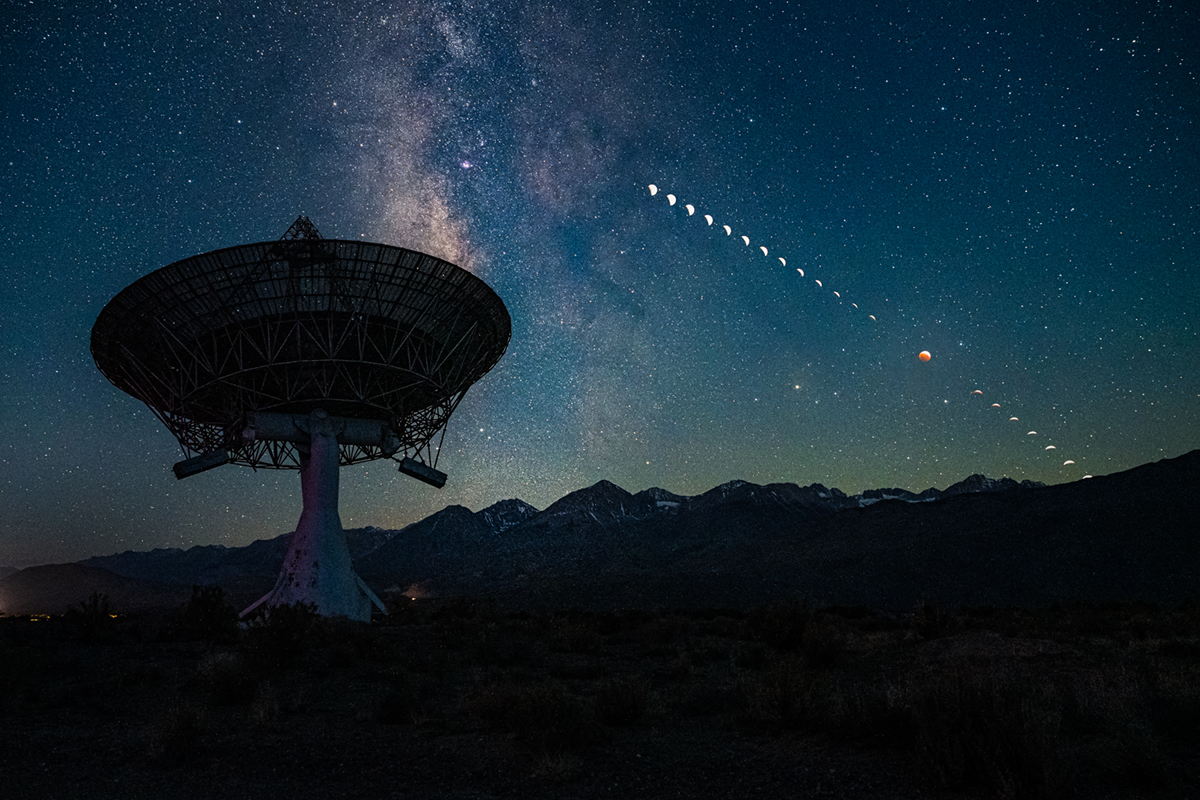
May's perigee Full Moon slid through Earth's shadow yesterday entertaining night skygazers in regions around the Pacific. Seen from western North America, it sinks toward the rugged Sierra Nevada mountain range in this time-lapse series of the total lunar eclipse. Low on the western horizon the Moon was captured at mid-eclipse with two separate exposures. Combined they reveal the eclipsed Moon's reddened color against the dark night sky and the diffuse starlight band of the Milky Way. Frames taken every five minutes from the fixed camera follow the surrounding progression of the eclipse partial phases. In the foreground a radio telescope dish at California's Owens Valley Radio Observatory points skyward.