The Moon
The Moon is Earth’s only natural satellite—a rocky, cratered body about one‑quarter the diameter of Earth, orbiting at an average distance of approximately 384,400 km. It influences tides, stabilizes Earth’s axial tilt, and was formed about 4.5 billion years ago following a collision between Earth and a Mars-sized object.
Source: science.nasa.gov
APODs including "The Moon"
Circular Sun Halo
10/06/2021
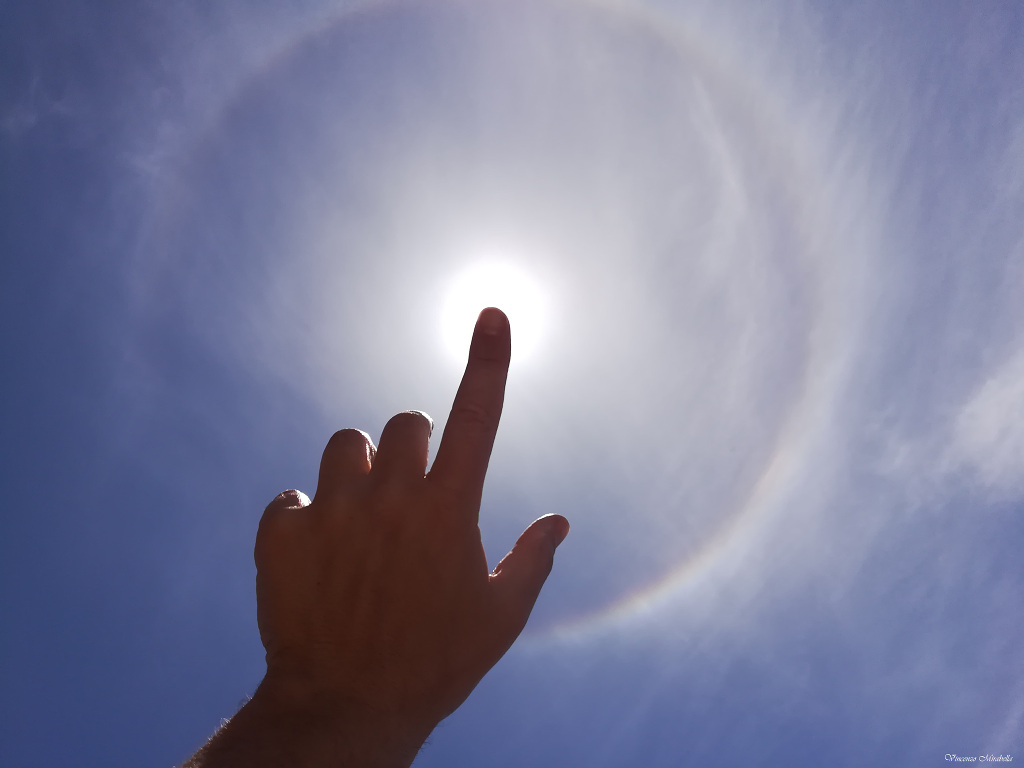
Want to see a ring around the Sun? It's easy to do in daytime skies around the world. Created by randomly oriented ice crystals in thin high cirrus clouds, circular 22 degree halos are visible much more often than rainbows. This one was captured by smart phone photography on May 29 near Rome, Italy. Carefully blocking the Sun, for example with a finger tip, is usually all that it takes to reveal the common bright halo ring. The halo's characteristic angular radius is about equal to the span of your hand, thumb to little finger, at the end of your outstretched arm. Want to see a ring of fire eclipse? That's harder. The spectacular annular phase of today's (June 10) solar eclipse, known as a ring of fire, was briefly visible only when standing along the Moon's narrow shadow track that passes over parts of northern Canada, Greenland, the Arctic, and eastern Russia. The solar eclipse was partial though, when seen from broader regions, including northern Asia, Europe, and parts of the US.