The Moon
The Moon is Earth’s only natural satellite—a rocky, cratered body about one‑quarter the diameter of Earth, orbiting at an average distance of approximately 384,400 km. It influences tides, stabilizes Earth’s axial tilt, and was formed about 4.5 billion years ago following a collision between Earth and a Mars-sized object.
Source: science.nasa.gov
APODs including "The Moon"
A View from Earth's Shadow
20/05/2022
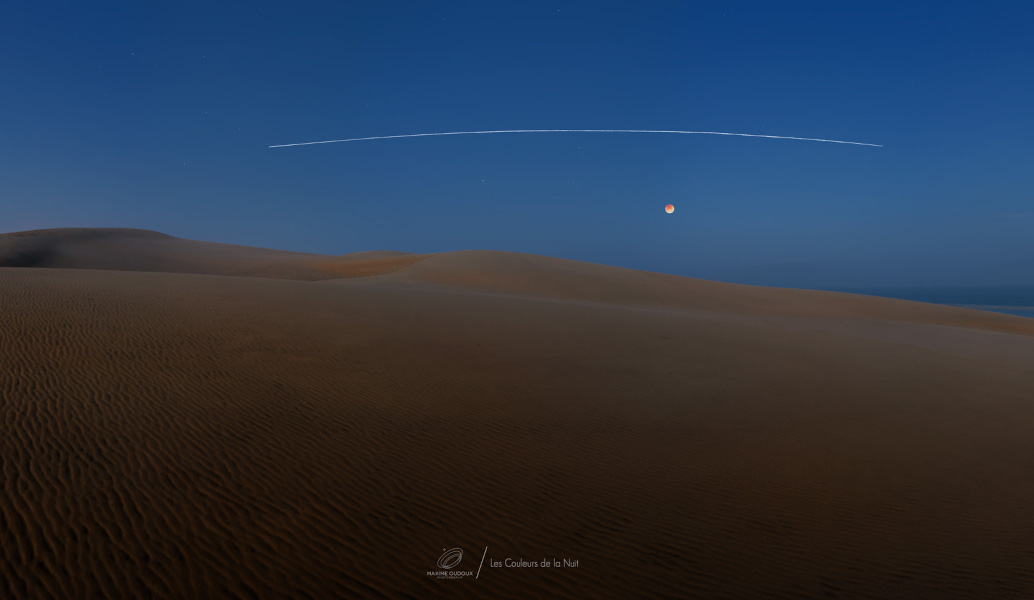
This serene sand and skyscape finds the Dune of Pilat on the coast of France still in Earth's shadow during the early morning hours of May 16. Extending into space, the planet's dark umbral shadow covered the Moon on that date. From that location the total phase of a lunar eclipse had begun before moonset. Still in sunlight though, the International Space Station crossed from the western horizon and Earth's largest artificial moon traced the bright flat arc through the sky over 400 km above. Simply constructed, the well-planned panoramic scene was captured over a 5 minutes in a series of consecutive images.