The Moon
The Moon is Earth’s only natural satellite—a rocky, cratered body about one‑quarter the diameter of Earth, orbiting at an average distance of approximately 384,400 km. It influences tides, stabilizes Earth’s axial tilt, and was formed about 4.5 billion years ago following a collision between Earth and a Mars-sized object.
Source: science.nasa.gov
APODs including "The Moon"
Crescent Moon Beyond Greek Temple
28/02/2023
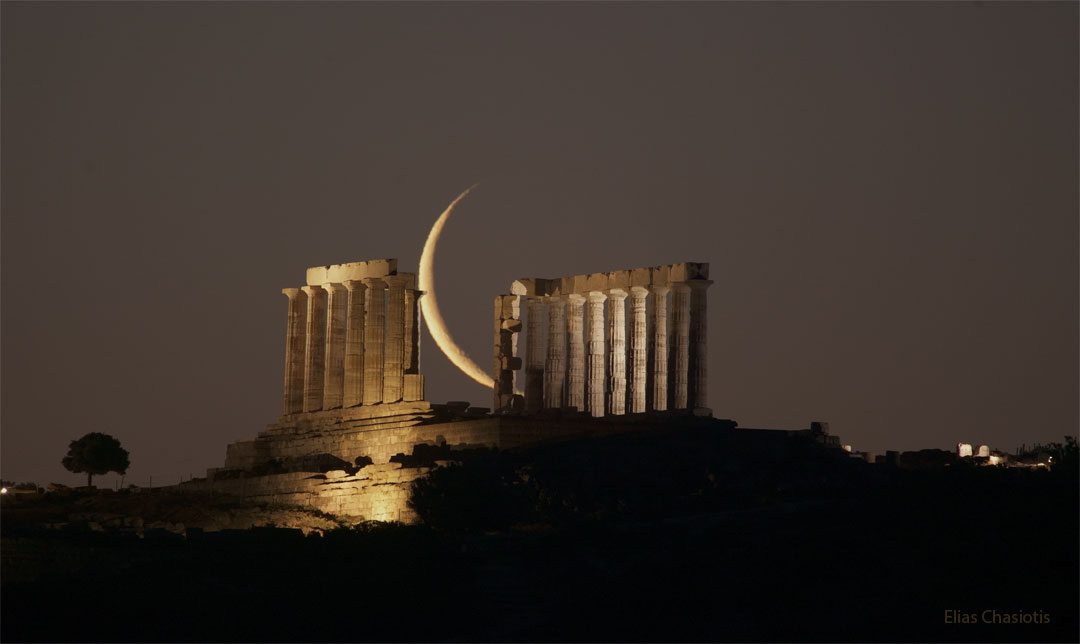
Why is a thin crescent moon never seen far from a horizon? Because the only geometry that gives a thin crescent lunar phase occurs when the Moon appears close to the Sun in the sky. The crescent is not caused by the shadow of the Earth, but by seeing only a small part of the Moon directly illuminated by the Sun. Moreover, the thickest part of the crescent always occurs in the direction of the Sun. In the evening, a thin crescent Moon will set shortly after the Sun and not be seen for the rest of the night. Alternatively, in the morning, a crescent Moon will rise shortly before the Sun after not being seen for most of the night. Pictured two weeks ago, a crescent moon was captured near the horizon, just before sunrise, far behind remnants of the ancient Temple of Poseidon in Greece.