The Moon
The Moon is Earth’s only natural satellite—a rocky, cratered body about one‑quarter the diameter of Earth, orbiting at an average distance of approximately 384,400 km. It influences tides, stabilizes Earth’s axial tilt, and was formed about 4.5 billion years ago following a collision between Earth and a Mars-sized object.
Source: science.nasa.gov
APODs including "The Moon"
The Ñandú in the Milky Way
20/06/2023
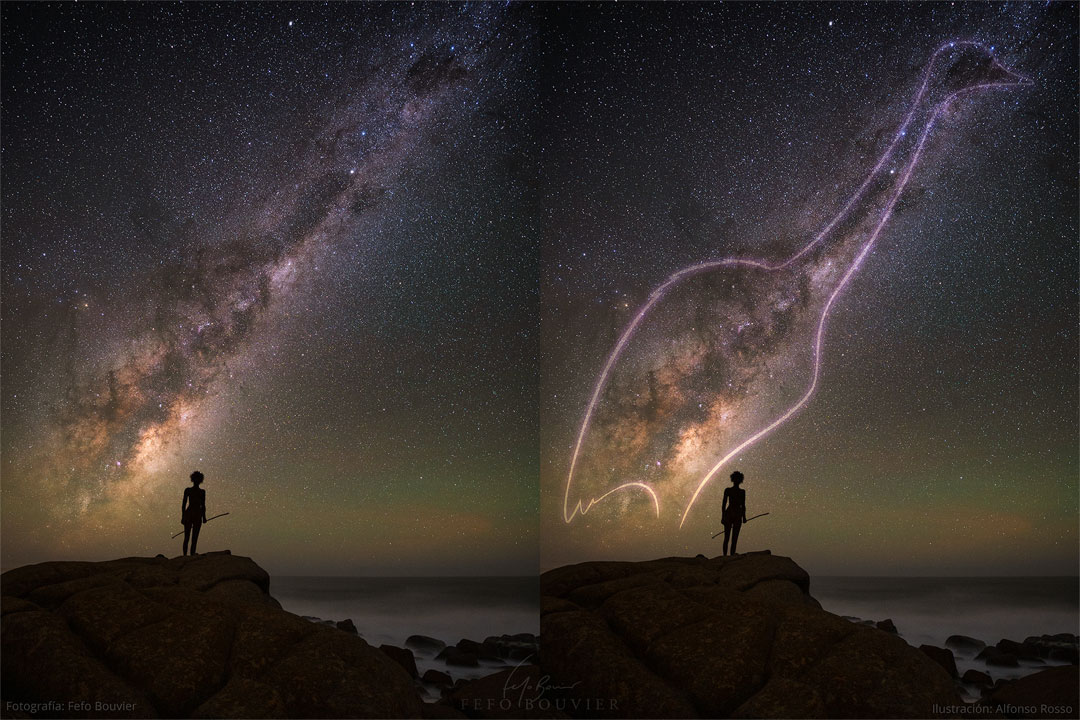
Have you seen the bird in the Milky Way? Beyond the man in the Moon, the night sky is filled with stories, and cultures throughout history have projected some of their most enduring legends onto the stars and dust above. Generations of people see these celestial icons, hear their associated stories, and pass them down. Pictured here is not only a segment of the central band of our Milky Way galaxy, but, according to folklore of several native peoples of Uruguay, the outline of a great bird called Ñandú. Furthermore, Ñandú's footprint is associated with the Southern Cross asterism. In the foreground, in silhouette, is a statue of María Micaela Guyunusa, an indigenous woman of the Charrúa people who lived in the 1800s and endures as a symbol of colonial resistance. The composite image was taken in mid-April in Cabo Polonio, Uruguay, with the Atlantic Ocean in the background.