The Moon
The Moon is Earth’s only natural satellite—a rocky, cratered body about one‑quarter the diameter of Earth, orbiting at an average distance of approximately 384,400 km. It influences tides, stabilizes Earth’s axial tilt, and was formed about 4.5 billion years ago following a collision between Earth and a Mars-sized object.
Source: science.nasa.gov
APODs including "The Moon"
PDS 70: Disk, Planets, and Moons
17/10/2023
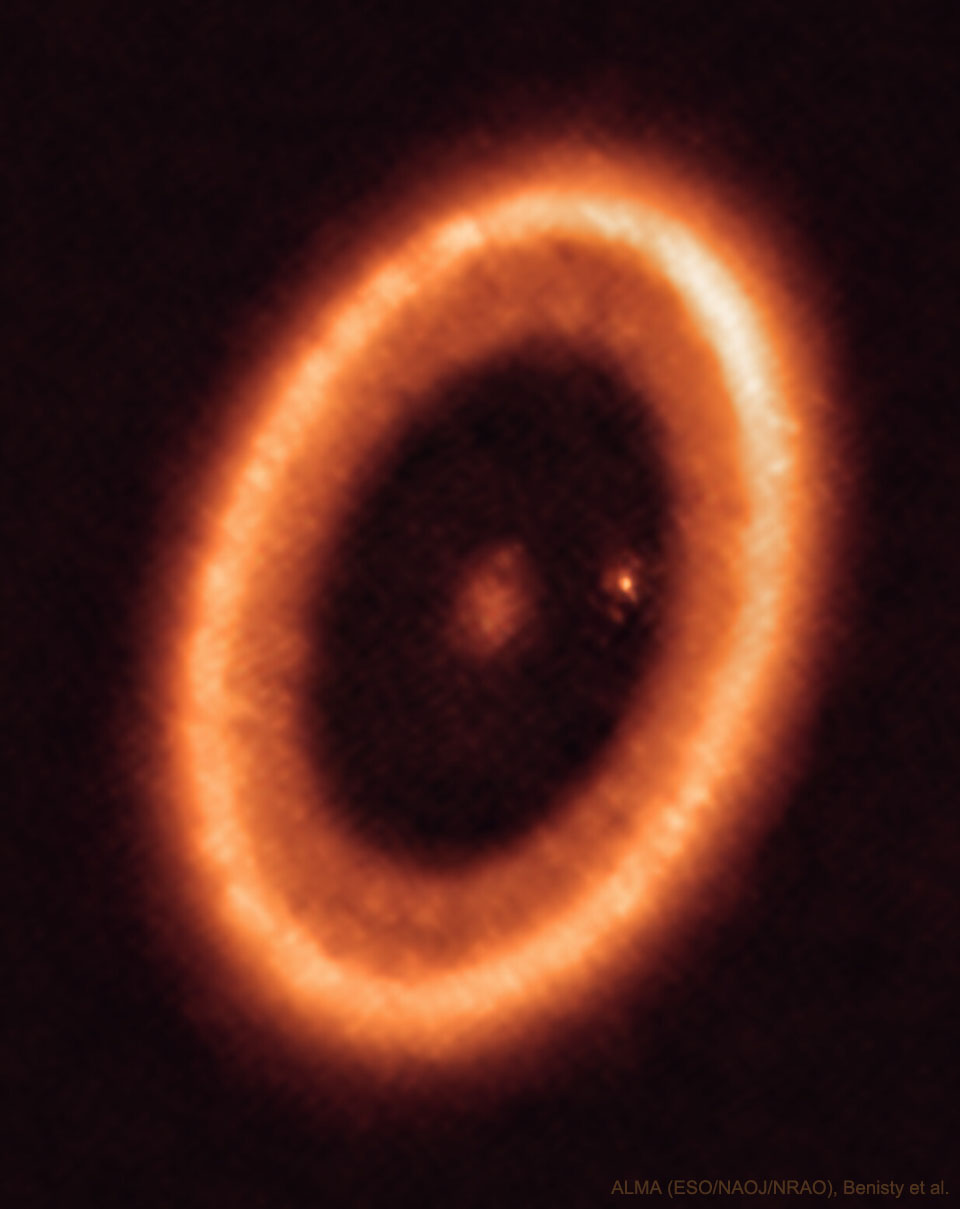
It's not the big ring that's attracting the most attention. Although the big planet-forming ring around the star PDS 70 is clearly imaged and itself quite interesting. It's also not the planet on the right, just inside the big disk, that’s being talked about the most. Although the planet PDS 70c is a newly formed and, interestingly, similar in size and mass to Jupiter. It's the fuzzy patch around the planet PDS 70c that's causing the commotion. That fuzzy patch is thought to be a dusty disk that is now forming into moons -- and that had never been seen before. The featured image was taken in 2021 by the Atacama Large Millimeter Array (ALMA) of 66 radio telescopes in the high Atacama Desert of northern Chile. Based on ALMA data, astronomers infer that the moon-forming exoplanetary disk has a radius similar to our Earth's orbit, and may one day form three or so Luna-sized moons -- not very different from our Jupiter's four.