The Moon
The Moon is Earth’s only natural satellite—a rocky, cratered body about one‑quarter the diameter of Earth, orbiting at an average distance of approximately 384,400 km. It influences tides, stabilizes Earth’s axial tilt, and was formed about 4.5 billion years ago following a collision between Earth and a Mars-sized object.
Source: science.nasa.gov
APODs including "The Moon"
Annular Solar Eclipse over Utah
01/11/2023
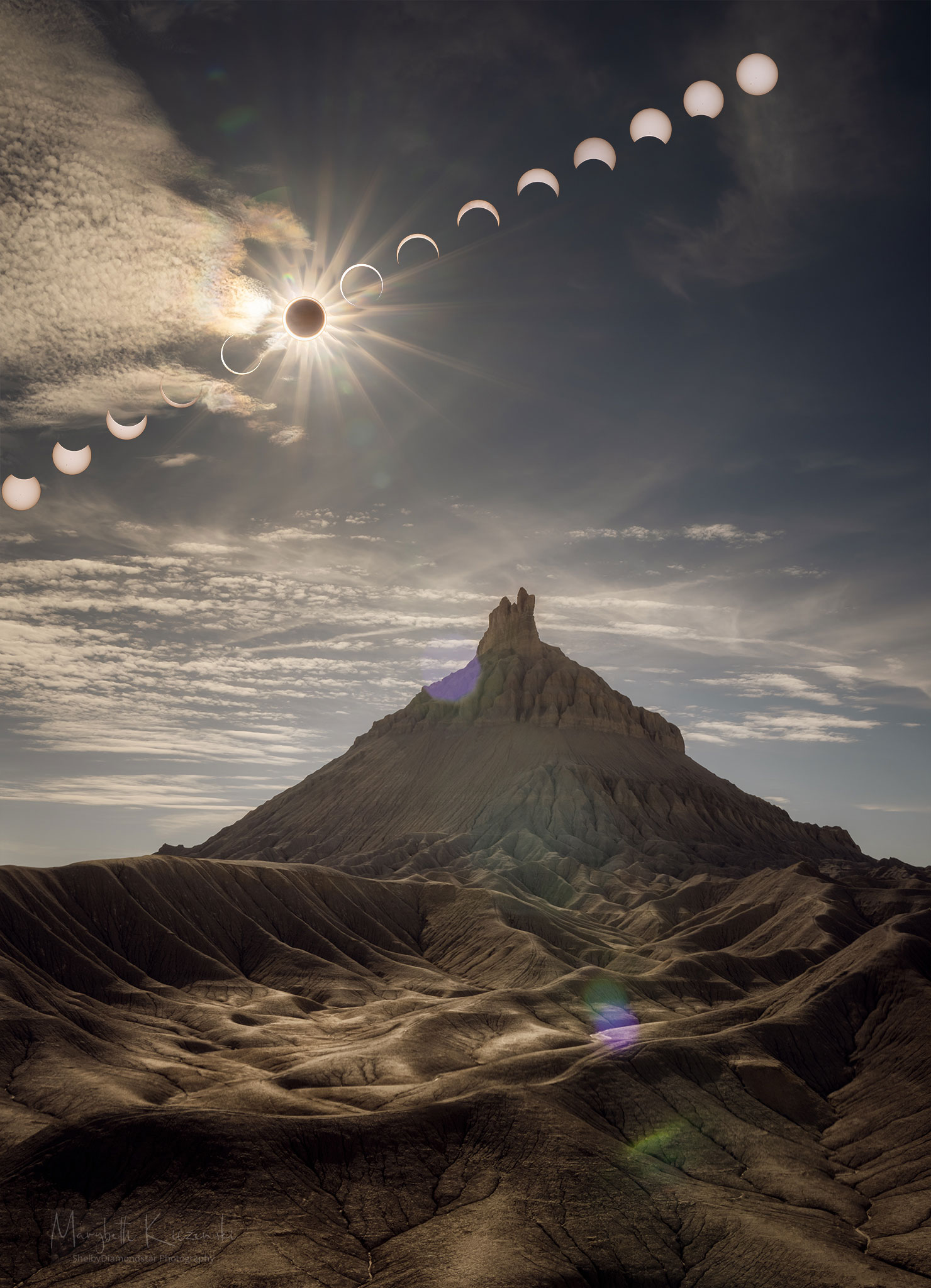
Part of the Sun disappeared earlier this month, but few people were worried. The missing part, which included the center from some locations, just went behind the Moon in what is known as an annular solar eclipse. Featured here is an eclipse sequence taken as the Moon was overtaking the rising Sun in the sky. The foreground hill is Factory Butte in Utah, USA. The rays flaring out from the Sun are not real -- they result from camera aperture diffraction and are known as sunstar. The Moon is real, but appears only in silhouette in this ring-of-fire eclipse. As stunning as this eclipse sequence is, it was considered just practice by the astrophotographer. The reason? She hopes to use this experience to better photograph the total solar eclipse that will occur over North America on April 8, 2024. Apply today (USA): Become a NASA Partner Eclipse Ambassador Eclipse Album: Selected images sent in to APOD