The Moon
The Moon is Earth’s only natural satellite—a rocky, cratered body about one‑quarter the diameter of Earth, orbiting at an average distance of approximately 384,400 km. It influences tides, stabilizes Earth’s axial tilt, and was formed about 4.5 billion years ago following a collision between Earth and a Mars-sized object.
Source: science.nasa.gov
APODs including "The Moon"
Three Planets Rock
14/11/2023
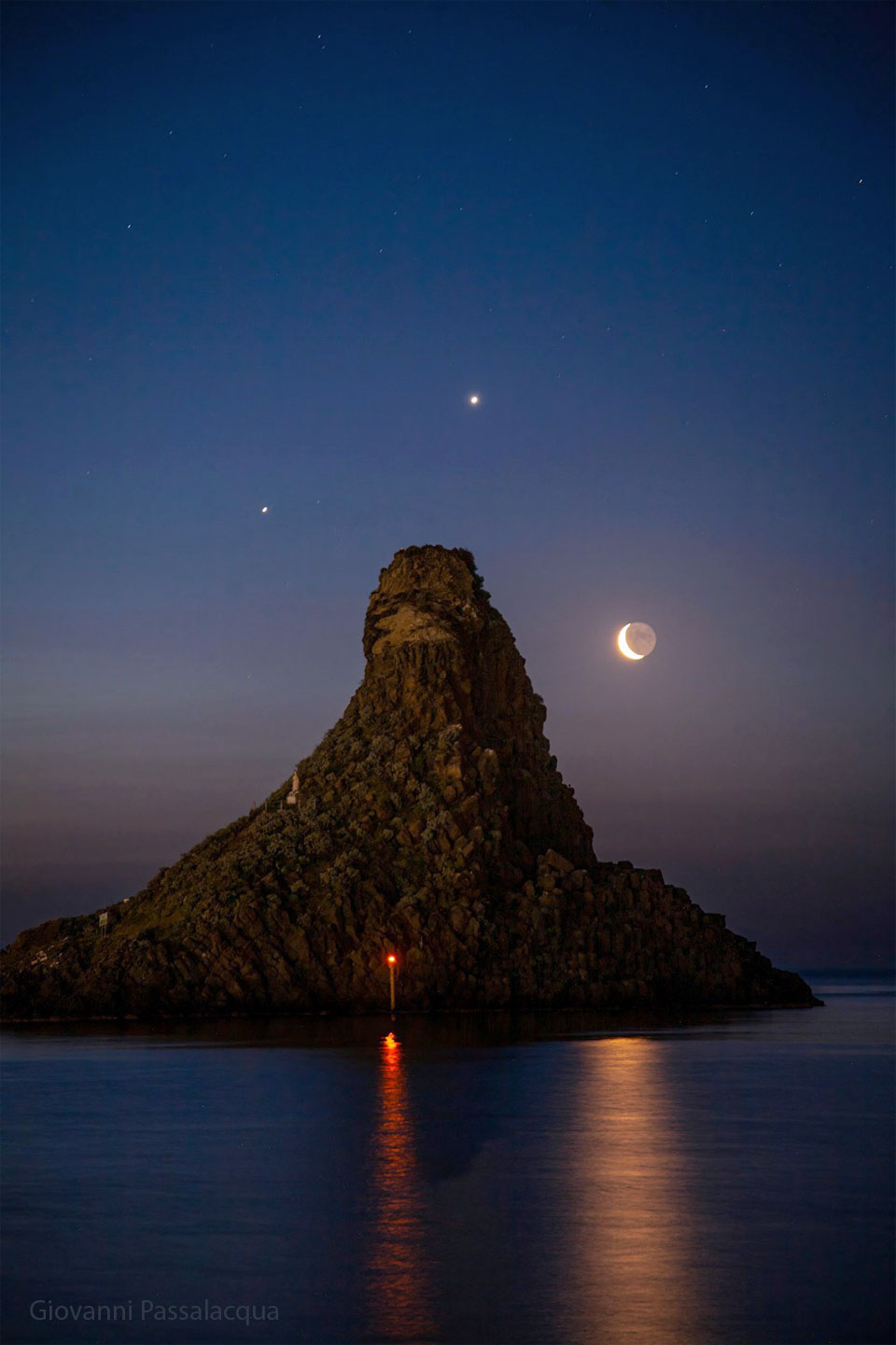
In the fading darkness before dawn, a tilted triangle appeared to balance atop a rock formation off the southern tip of Sicily. Making up the points of the triangle are three of the four brightest objects visible in Earth’s sky: Jupiter, Venus and the Moon. Though a thin waning crescent, most of the moon’s disk is visible due to earthshine. Captured in this image on 2022 April 27, Venus (center) and Jupiter (left) are roughly three degrees apart -- and were headed toward a close conjunction. Conjunctions of Venus and Jupiter occur about once a year and are visible either in the east before sunrise or in the west after sunset. The featured image was taken about an hour before the arrival of the brightest object in Earth’s sky – the Sun.