The Moon
The Moon is Earth’s only natural satellite—a rocky, cratered body about one‑quarter the diameter of Earth, orbiting at an average distance of approximately 384,400 km. It influences tides, stabilizes Earth’s axial tilt, and was formed about 4.5 billion years ago following a collision between Earth and a Mars-sized object.
Source: science.nasa.gov
APODs including "The Moon"
Startrails over Beijing Ancient Observatory
02/12/2023
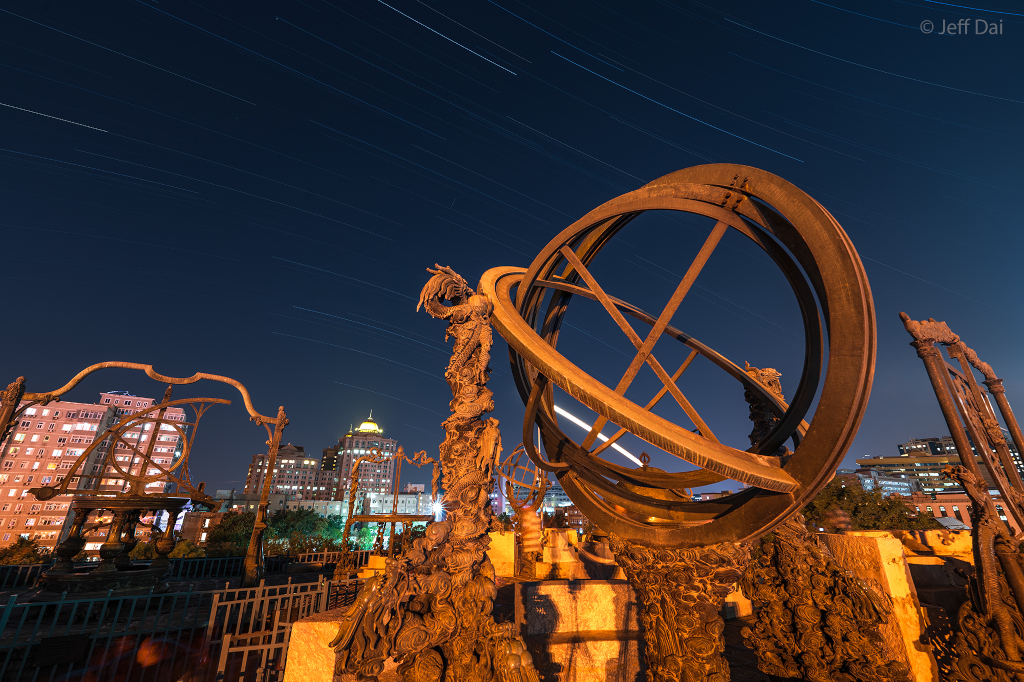
You can take a subway ride to visit this observatory in Beijing, China but you won't find any telescopes there. Starting in the 1400s astronomers erected devices at the Beijing Ancient Observatory site to enable them to accurately measure and track the positions of naked-eye stars and planets. Some of the large, ornate astronomical instruments are still standing. You can even see stars from the star observation platform today, but now only the very brightest celestial beacons are visible against the city lights. In this time series of exposures from a camera fixed to a tripod to record graceful arcing startrails, the brightest trail is actually the Moon. Its broad arc is seen behind the ancient observatory's brass armillary sphere. Compare this picture from the Beijing Ancient Observatory taken in September 2023 to one taken in 1895.