The Moon
The Moon is Earth’s only natural satellite—a rocky, cratered body about one‑quarter the diameter of Earth, orbiting at an average distance of approximately 384,400 km. It influences tides, stabilizes Earth’s axial tilt, and was formed about 4.5 billion years ago following a collision between Earth and a Mars-sized object.
Source: science.nasa.gov
APODs including "The Moon"
SLIM Lands on the Moon
30/01/2024
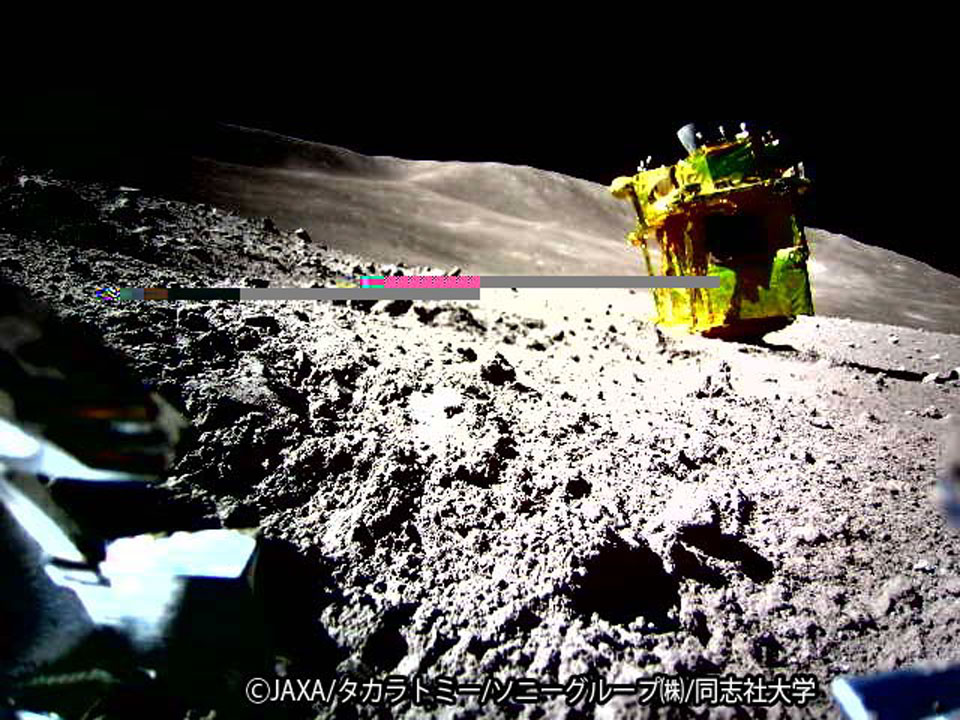
New landers are on the Moon. Nearly two weeks ago, Japan's Smart Lander for Investigating Moon (SLIM) released two rovers as it descended, before its main lander touched down itself. The larger of the two rovers can hop like a frog, while the smaller rover is about the size of a baseball and can move after pulling itself apart like a transformer. The main lander, nicknamed Moon Sniper, is seen in the featured image taken by the smaller rover. Inspection of the image shows that Moon Sniper's thrusters are facing up, meaning that the lander is upside down from its descent configuration and on its side from its intended landing configuration. One result is that Moon Sniper's solar panels are not in the expected orientation, so that powering the lander had to be curtailed and adapted. SLIM's lander has already succeeded as a technology demonstration, its main mission, but was not designed to withstand the lunar night -- which starts tomorrow.