The Moon
The Moon is Earth’s only natural satellite—a rocky, cratered body about one‑quarter the diameter of Earth, orbiting at an average distance of approximately 384,400 km. It influences tides, stabilizes Earth’s axial tilt, and was formed about 4.5 billion years ago following a collision between Earth and a Mars-sized object.
Source: science.nasa.gov
APODs including "The Moon"
A Full Plankton Moon
11/03/2024
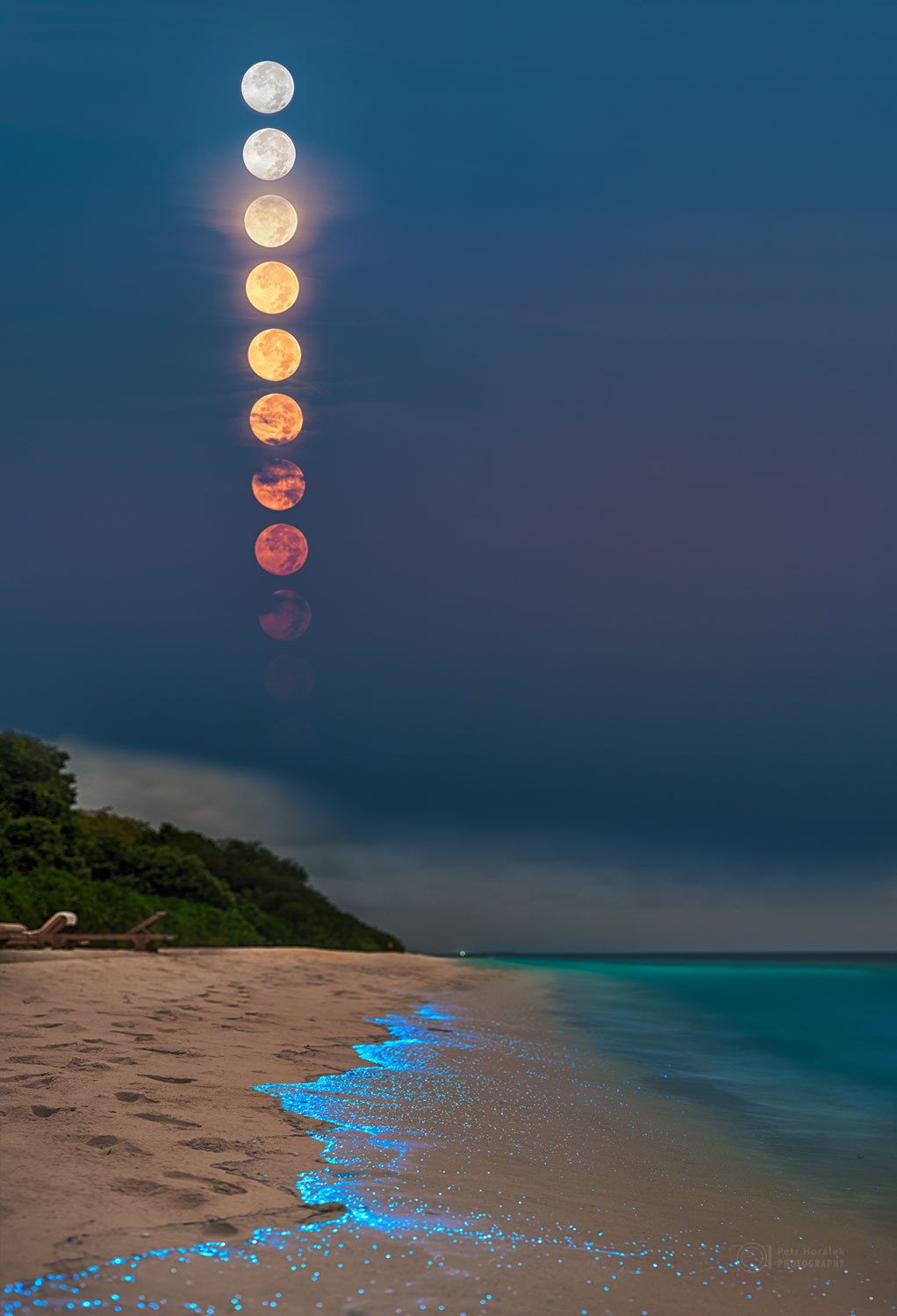
What glows in the night? This night featured a combination of usual and unusual glows. Perhaps the most usual glow was from the Moon, a potentially familiar object. The full Moon's nearly vertical descent results from the observer being near Earth's equator. As the Moon sets, air and aerosols in Earth's atmosphere preferentially scatter out blue light, making the Sun-reflecting satellite appear reddish when near the horizon. Perhaps the most unusual glow was from the bioluminescent plankton, likely less familiar objects. These microscopic creatures glow blue, it is thought, primarily to surprise and deter predators. In this case, the glow was caused primarily by plankton-containing waves crashing onto the beach. The image was taken on Soneva Fushi Island, Maldives just over one year ago. Your Sky Surprise: What picture did APOD feature on your birthday? (post 1995)