The Moon
The Moon is Earth’s only natural satellite—a rocky, cratered body about one‑quarter the diameter of Earth, orbiting at an average distance of approximately 384,400 km. It influences tides, stabilizes Earth’s axial tilt, and was formed about 4.5 billion years ago following a collision between Earth and a Mars-sized object.
Source: science.nasa.gov
APODs including "The Moon"
Galileo's Europa
29/03/2024
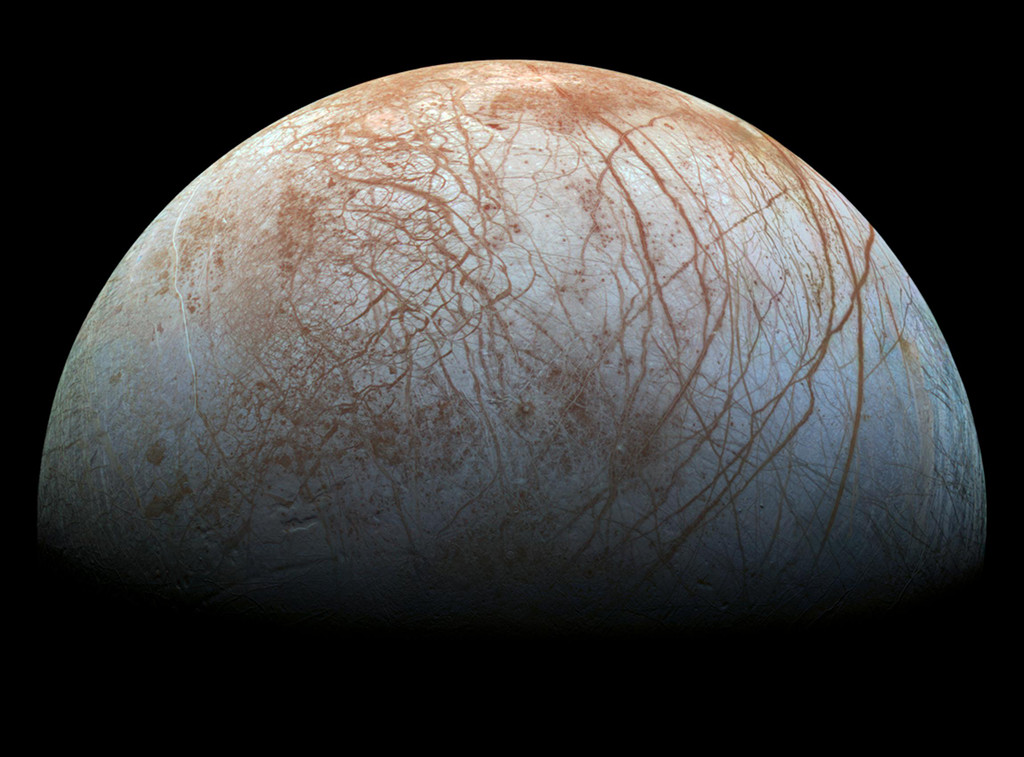
Looping through the Jovian system in the late 1990s, the Galileo spacecraft recorded stunning views of Europa and uncovered evidence that the moon's icy surface likely hides a deep, global ocean. Galileo's Europa image data has been remastered here, with improved calibrations to produce a color image approximating what the human eye might see. Europa's long curving fractures hint at the subsurface liquid water. The tidal flexing the large moon experiences in its elliptical orbit around Jupiter supplies the energy to keep the ocean liquid. But more tantalizing is the possibility that even in the absence of sunlight that process could also supply the energy to support life, making Europa one of the best places to look for life beyond Earth. The Juno spacecraft currently in Jovian orbit has also made repeated flybys of the water world, returning images along with data exploring Europa's habitability. This October will see the launch of the NASA's Europa Clipper on a voyage of exploration. The spacecraft will make nearly 50 flybys, approaching to within 25 kilometers of Europa's icy surface.