The Moon
The Moon is Earth’s only natural satellite—a rocky, cratered body about one‑quarter the diameter of Earth, orbiting at an average distance of approximately 384,400 km. It influences tides, stabilizes Earth’s axial tilt, and was formed about 4.5 billion years ago following a collision between Earth and a Mars-sized object.
Source: science.nasa.gov
APODs including "The Moon"
Total Eclipse and Comets
17/04/2024
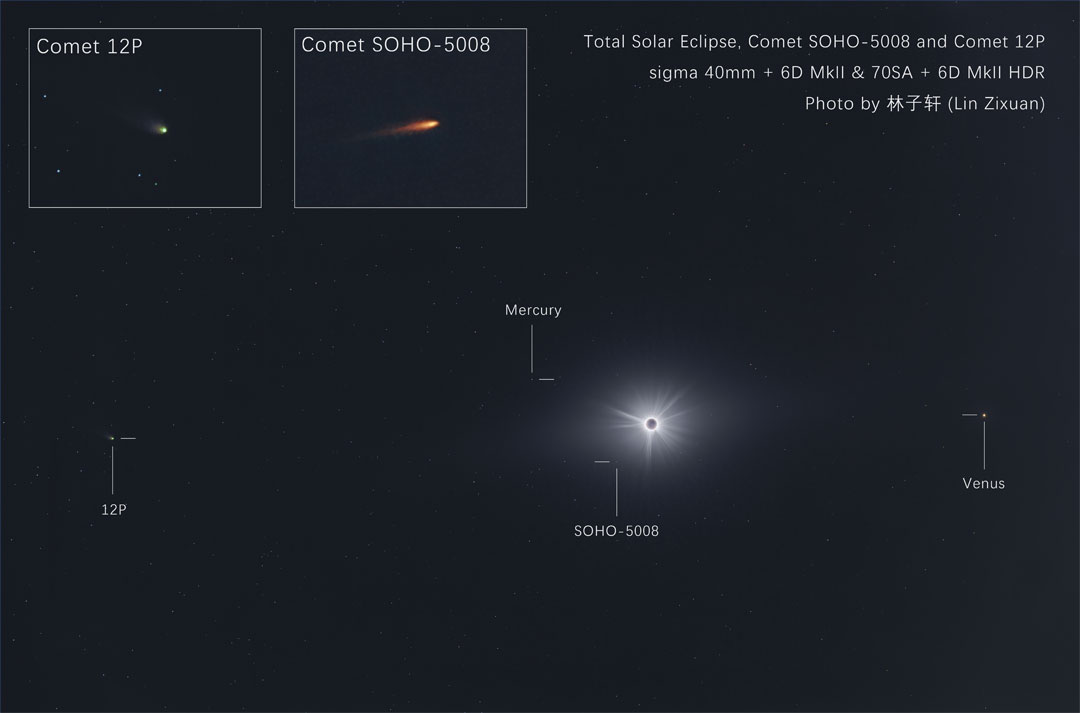
Not one, but two comets appeared near the Sun during last week's total solar eclipse. The expected comet was Comet 12P/Pons-Brooks, but it was disappointingly dimmer than many had hoped. However, relatively unknown Comet SOHO-5008 also appeared in long duration camera exposures. This comet was the 5008th comet identified on images taken by ESA & NASA's Sun-orbiting SOHO spacecraft. Likely much smaller, Comet SOHO-5008 was a sungrazer which disintegrated within hours as it passed too near the Sun. The featured image is not only unusual for capturing two comets during an eclipse, but one of the rare times that a sungrazing comet has been photographed from the Earth's surface. Also visible in the image is the sprawling corona of our Sun and the planets Mercury (left) and Venus (right). Of these planets and comets, only Venus was easily visible to millions of people in the dark shadow of the Moon that crossed North America on April 8. Solar Eclipse Imagery: Notable Submissions to APOD