The Moon
The Moon is Earth’s only natural satellite—a rocky, cratered body about one‑quarter the diameter of Earth, orbiting at an average distance of approximately 384,400 km. It influences tides, stabilizes Earth’s axial tilt, and was formed about 4.5 billion years ago following a collision between Earth and a Mars-sized object.
Source: science.nasa.gov
APODs including "The Moon"
Comet, Planet, Moon
29/04/2024
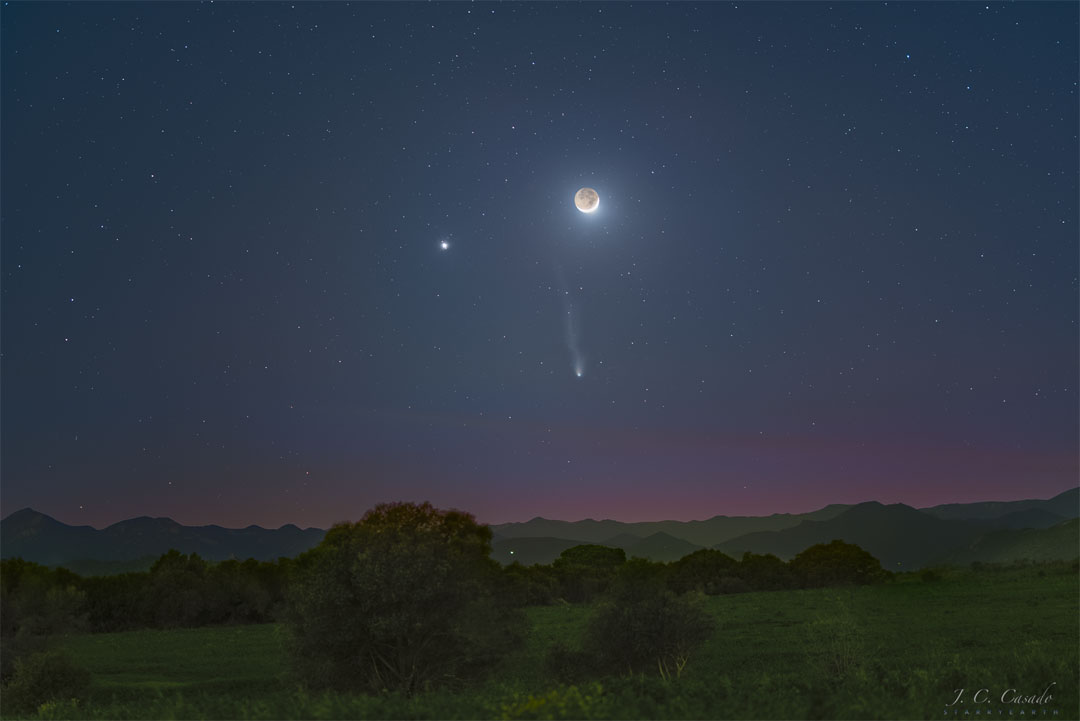
Three bright objects satisfied seasoned stargazers of the western sky just after sunset earlier this month. The most familiar was the Moon, seen on the upper left in a crescent phase. The rest of the Moon was faintly visible by sunlight first reflected by the Earth. The bright planet Jupiter, the largest planet in the Solar System, is seen to the upper left. Most unusual was Comet 12P/Pons-Brooks, below the Moon and showing a stubby dust tail on the right but an impressive ion tail extending upwards. The featured image, a composite of several images taken consecutively at the same location and with the same camera, was taken near the village of Llers, in Spain's Girona province. Comet Pons-Brooks passed its closest to the Sun last week and is now dimming as it moves into southern skies and returns to the outer Solar System. Almost Hyperspace: Random APOD Generator