The Moon
The Moon is Earth’s only natural satellite—a rocky, cratered body about one‑quarter the diameter of Earth, orbiting at an average distance of approximately 384,400 km. It influences tides, stabilizes Earth’s axial tilt, and was formed about 4.5 billion years ago following a collision between Earth and a Mars-sized object.
Source: science.nasa.gov
APODs including "The Moon"
Saturn at the Moon's Edge
27/07/2024
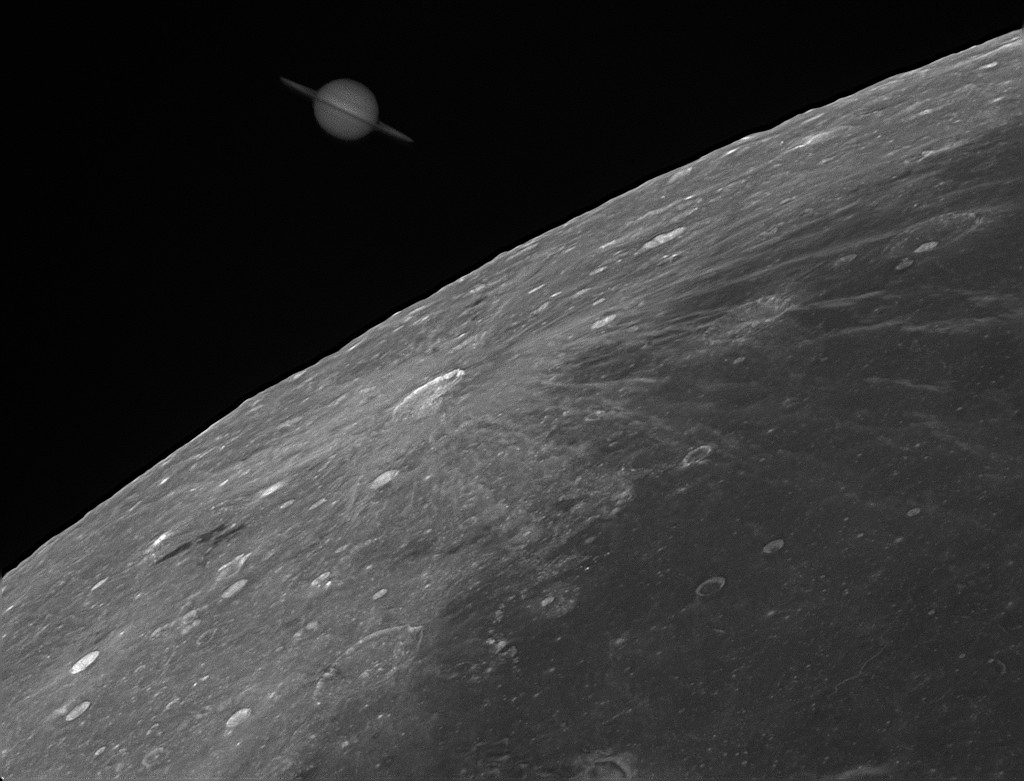
Saturn now rises before midnight in planet Earth's sky. On July 24, the naked-eye planet was in close conjunction, close on the sky, to a waning gibbous Moon. But from some locations on planet Earth the ringed gas giant was occulted, disappearing behind the Moon for about an hour from skies over parts of Asia and Africa. Because the Moon and bright planets wander through the sky near the ecliptic plane, such occultation events are not uncommon, but they can be dramatic. In this telescopic view from Nanjing, Jiangsu, China, Saturn is caught moments before its disappearance behind the lunar disk. The snapshot gives the illusion that Saturn hangs just above Glushko crater, a 43 kilometer diameter, young, ray crater near the Moon's western edge. Of course, the Moon is 400 thousand kilometers away, compared to Saturn's distance of 1.4 billion kilometers.