The Moon
The Moon is Earth’s only natural satellite—a rocky, cratered body about one‑quarter the diameter of Earth, orbiting at an average distance of approximately 384,400 km. It influences tides, stabilizes Earth’s axial tilt, and was formed about 4.5 billion years ago following a collision between Earth and a Mars-sized object.
Source: science.nasa.gov
APODs including "The Moon"
Moonquakes Surprisingly Common
06/04/2025
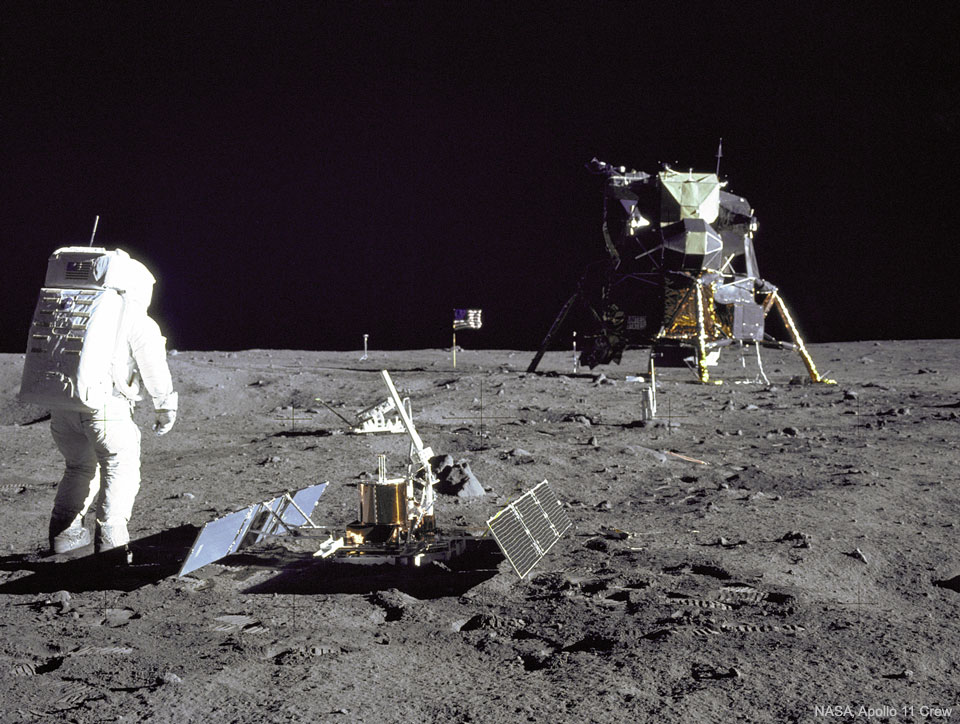
Why are there so many moonquakes? Analyses of seismometers left on the moon during the Apollo moon landings reveal a surprising number of moonquakes occurring within 100 kilometers of the surface. In fact, 62 moonquakes were detected in data recorded between 1972 and 1977. Many of these moonquakes are not only strong enough to move furniture in a lunar apartment, but the stiff rock of the moon continues to vibrate for many minutes, significantly longer than the softer rock earthquakes on Earth. The cause of the moonquakes remains unknown, but a leading hypothesis includes tidal gravity from -- and relative heating by -- our Earth. Regardless of the source, future moon dwellings need to be built to withstand the frequent shakings. Pictured here, Apollo 11 astronaut Buzz Aldrin stands beside a recently deployed lunar seismometer, looking back toward the lunar landing module. Explore Your Universe: Random APOD Generator