The Moon
The Moon is Earth’s only natural satellite—a rocky, cratered body about one‑quarter the diameter of Earth, orbiting at an average distance of approximately 384,400 km. It influences tides, stabilizes Earth’s axial tilt, and was formed about 4.5 billion years ago following a collision between Earth and a Mars-sized object.
Source: science.nasa.gov
APODs including "The Moon"
A Happy Sky over Bufa Hill in Mexico
30/04/2025
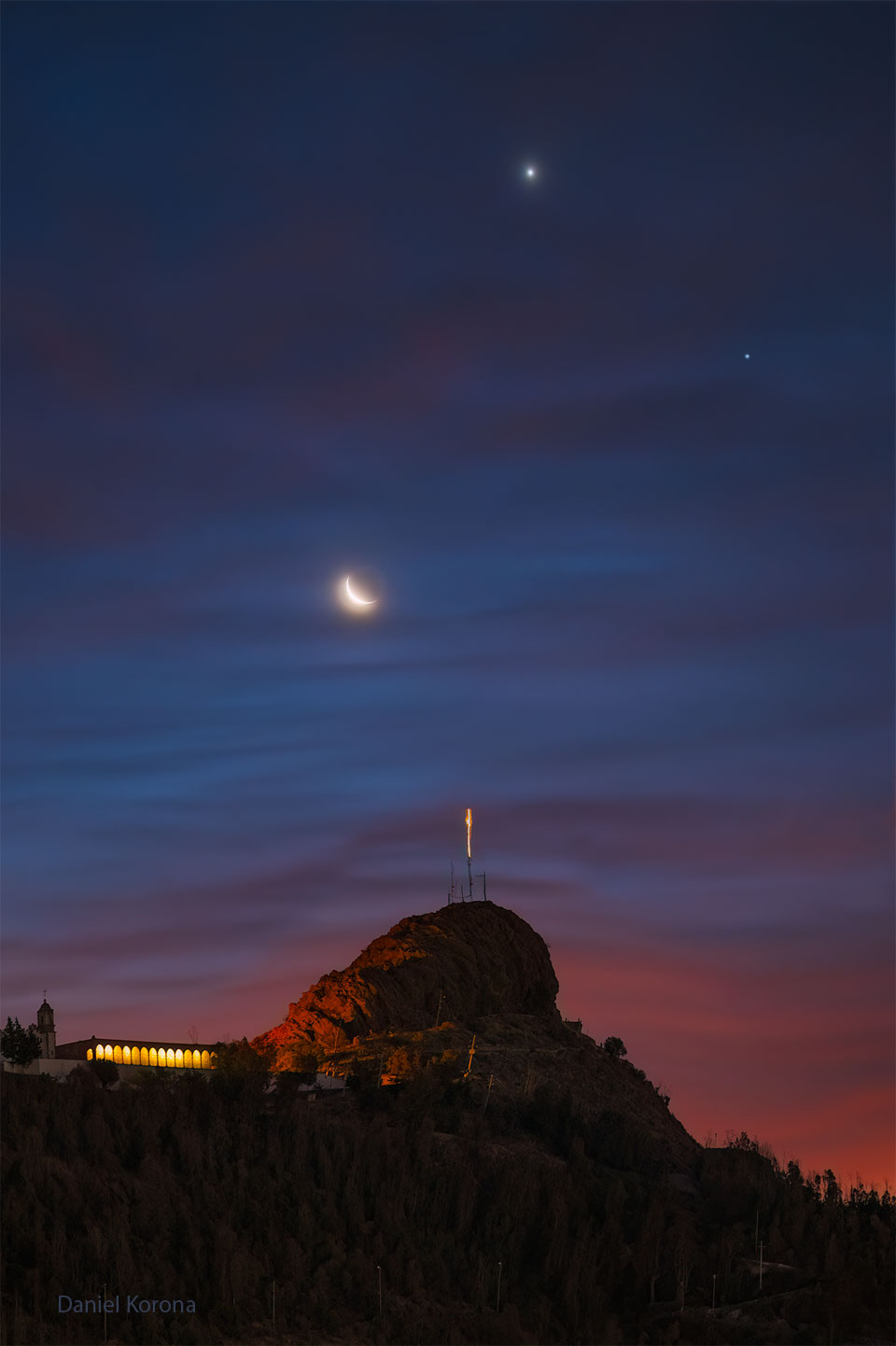
Sometimes, the sky itself seems to smile. A few days ago, visible over much of the world, an unusual superposition of our Moon with the planets Venus and Saturn created just such an iconic facial expression. Specifically, a crescent Moon appeared to make a happy face on the night sky when paired with seemingly nearby planets. Pictured is the scene as it appeared over Zacatecas, México, with distinctive Bufa Hill in the foreground. On the far right and farthest in the distance is the planet Saturn. Significantly closer and visible to Saturn's upper left is Venus, the brightest planet on the sky. Just above the central horizon is Earth's Moon in a waning crescent phase. To create this gigantic icon, the crescent moon phase must be smiling in the correct direction. Dial-A-Moon: Find the Moon phase on your birthday this year