The Moon
The Moon is Earth’s only natural satellite—a rocky, cratered body about one‑quarter the diameter of Earth, orbiting at an average distance of approximately 384,400 km. It influences tides, stabilizes Earth’s axial tilt, and was formed about 4.5 billion years ago following a collision between Earth and a Mars-sized object.
Source: science.nasa.gov
APODs including "The Moon"
Two Eclipses of Saros 133
07/03/2026
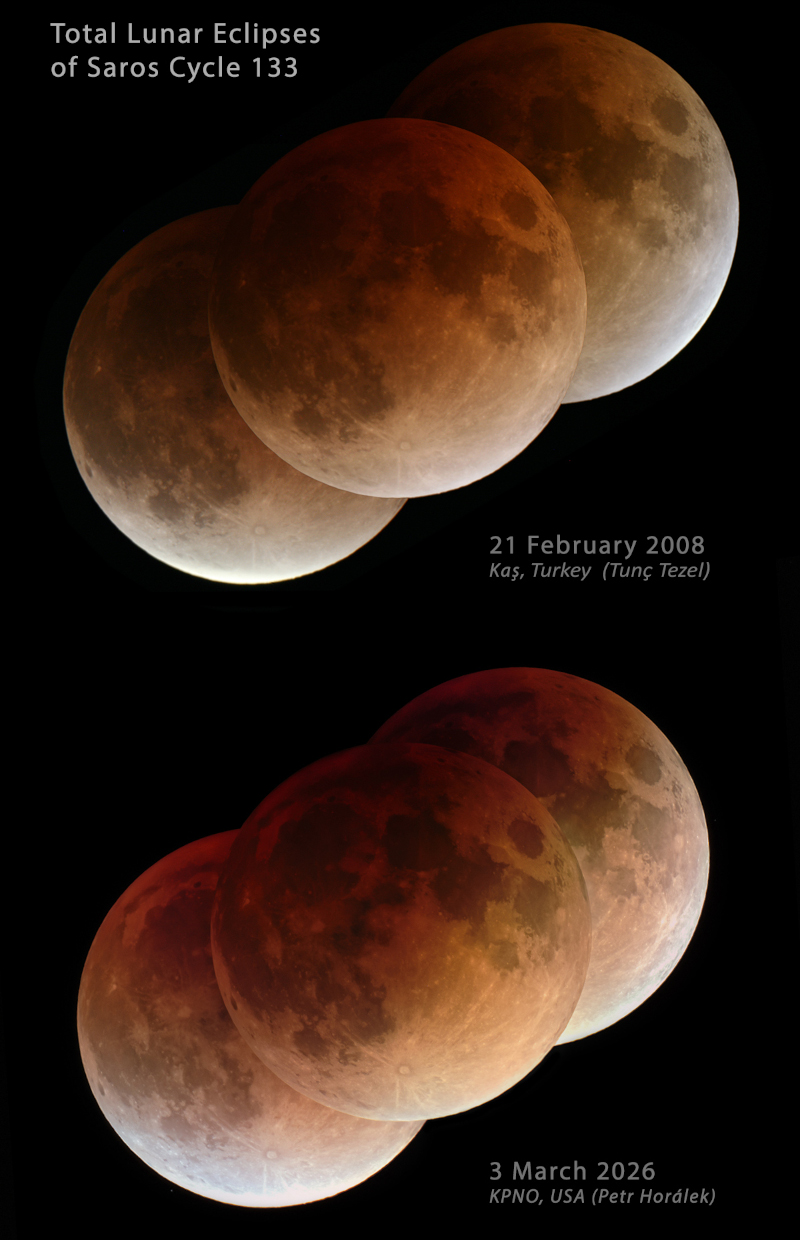
Centered on maximum eclipse, these two total lunar eclipse sequences look almost identical. Yet the one shown on top is composed of images recorded in February 2008, while at the bottom is the recent March 2026 total eclipse of the Moon. Why are they so similar? Because these two total lunar eclipses are from the same Saros cycle. The Saros cycle was discovered historically from observations of the Moon's orbit. With a period of 18 years, 11 and 1/3 days, the cycle predicts when the Sun, Earth, and Moon all return to the same relative geometry for a lunar (or solar) eclipse. Eclipses separated by one Saros period belong to the same numbered Saros series, in this case Saros 133. So expect the next lunar eclipse in Saros 133 to be a repeat of this year's March 3 eclipse. You can watch the next Saros 133 total lunar eclipse on March 13, 2044. Growing Gallery: Total Lunar Eclipse of March 3