The Moon
The Moon is Earth’s only natural satellite—a rocky, cratered body about one‑quarter the diameter of Earth, orbiting at an average distance of approximately 384,400 km. It influences tides, stabilizes Earth’s axial tilt, and was formed about 4.5 billion years ago following a collision between Earth and a Mars-sized object.
Source: science.nasa.gov
APODs including "The Moon"
Toolondo Totality Trails
13/03/2026
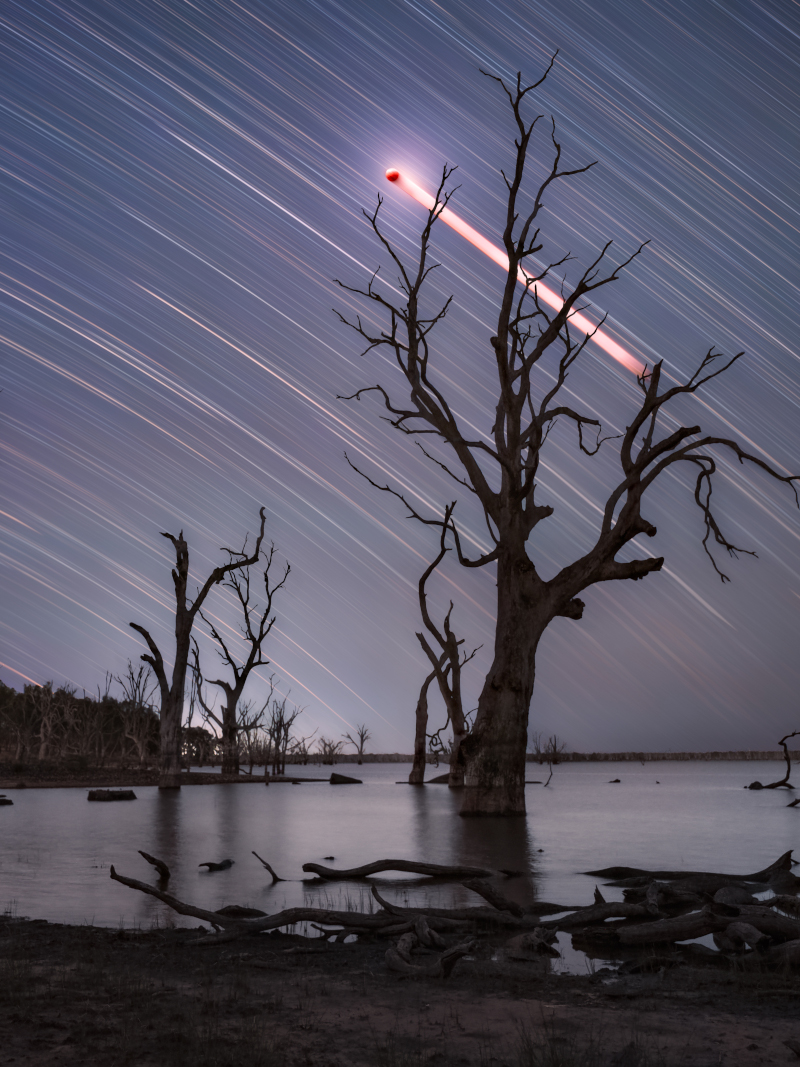
In this composited night skyscape, stacked exposures trace graceful star trails above Lake Toolondo, Victoria, Australia, planet Earth. Captured while the lunar eclipse of March 3 was in progress, the exposures used were made during the hour-long total eclipse phase. So faint star trails are easily visible along with the trail of the reddened Moon in the eclipse-darkened skies above the lake and trees. Of course, the apparent motion of Moon and stars revealed in the timelapse composite reflect the Earth's daily rotation around its axis. Dramatically punctuating the Moon's trail as totality ended, a single, separate telephoto image of the totally eclipsed Moon was scaled and blended into the scene. Growing Gallery: Total Lunar Eclipse of March 3