The Moon
The Moon is Earth’s only natural satellite—a rocky, cratered body about one‑quarter the diameter of Earth, orbiting at an average distance of approximately 384,400 km. It influences tides, stabilizes Earth’s axial tilt, and was formed about 4.5 billion years ago following a collision between Earth and a Mars-sized object.
Source: science.nasa.gov
APODs including "The Moon"
Robert Goddard and Nell
28/03/2026
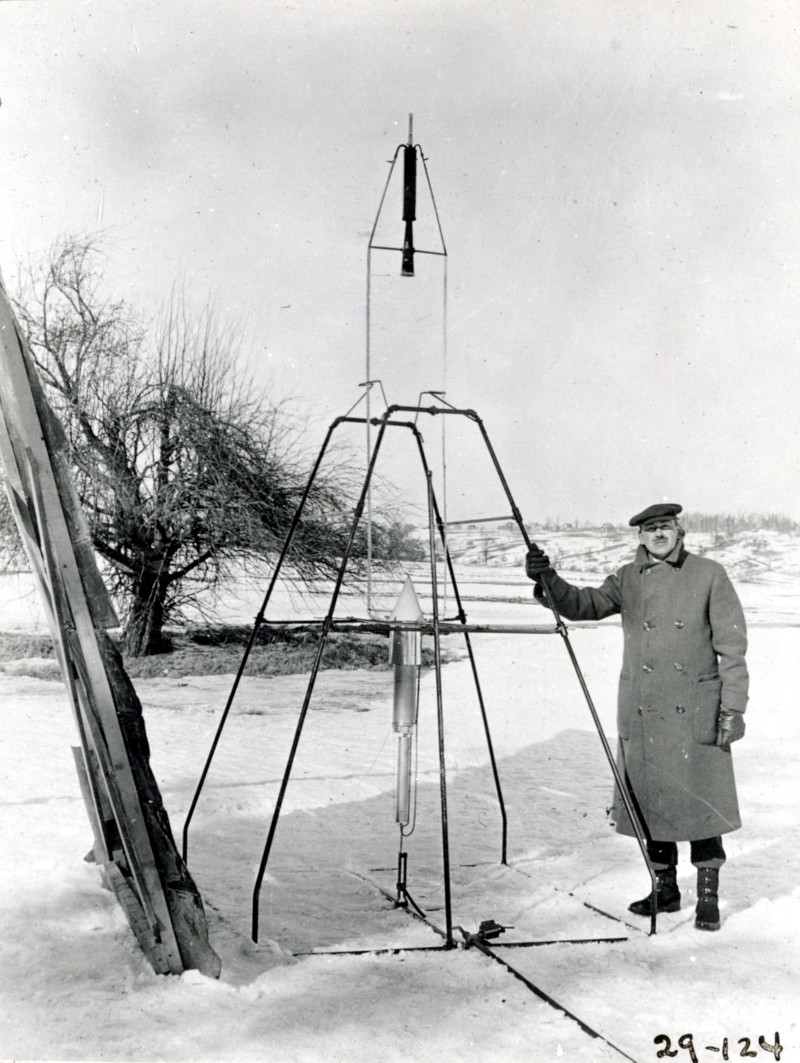
Robert H. Goddard, considered the father of modern rocketry, was born in Worcester Massachusetts in 1882. As a 16 year old, Goddard read H.G. Wells' science fiction classic "War Of The Worlds" and dreamed of space flight. By 1926 he had designed, built, and flown the world's first liquid fuel rocket. Launched 100 years ago, on March 16, 1926 from his aunt Effie's farm in Auburn Massachusetts, the rocket dubbed "Nell", rose to an altitude of 41 feet in a flight that lasted about 2 1/2 seconds. In this posed photo Goddard stands next to the 10 foot tall rocket, holding the launch stand frame. To achieve a stable flight without the need for fins, the rocket's heavy motor was located at the top, fed by lines from liquid oxygen and gasoline fuel tanks at the bottom. Widely recognized as a gifted experimenter and engineering genius, his rockets were many years ahead of their time. Goddard was awarded over 200 patents in rocket technology, most of them after his death in 1945. A liquid fuel rocket constructed on principles developed by Goddard landed humans on the Moon in 1969.