The Moon
The Moon is Earth’s only natural satellite—a rocky, cratered body about one‑quarter the diameter of Earth, orbiting at an average distance of approximately 384,400 km. It influences tides, stabilizes Earth’s axial tilt, and was formed about 4.5 billion years ago following a collision between Earth and a Mars-sized object.
Source: science.nasa.gov
APODs including "The Moon"
Earthset
08/04/2026
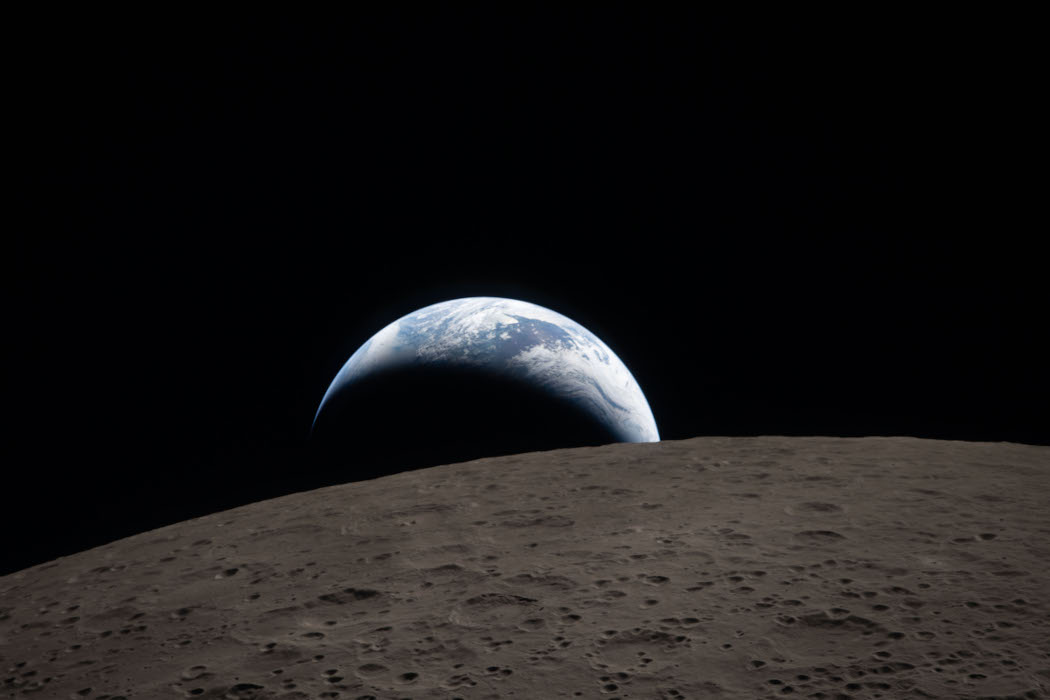
And to all of you down there on Earth and around Earth, we love you, from the Moon. We will see you on the other side, said Artemis II pilot Victor Glover on April 6th at 6:44pm ET as 8.3 billion minus four people and one Earth set below the Moon's horizon. The Orion spacecraft, Integrity, then traveled behind the Moon as part of its seven-hour lunar flyby. The crew characterized never-before-seen regions of the far side of the Moon, which is puzzlingly less volcanically active than the near side. New observations of crater peaks, floors, terraces, and rings preserved on the lunar surface will help piece together the impact history of the Solar System. Among many other surface characterizations, the crew observed one of the Moon's best-preserved basins, the Orientale basin, and identified two new craters. As Earth rose above the Moon’s horizon and Integrity began its return home, Artemis II mission specialist Christina Koch powerfully summarized humanity’s grander mission: ...we will always choose Earth. We will always choose each other.