The Moon
The Moon is Earth’s only natural satellite—a rocky, cratered body about one‑quarter the diameter of Earth, orbiting at an average distance of approximately 384,400 km. It influences tides, stabilizes Earth’s axial tilt, and was formed about 4.5 billion years ago following a collision between Earth and a Mars-sized object.
Source: science.nasa.gov
APODs including "The Moon"
Supermoon Versus Micromoon
30/05/2026
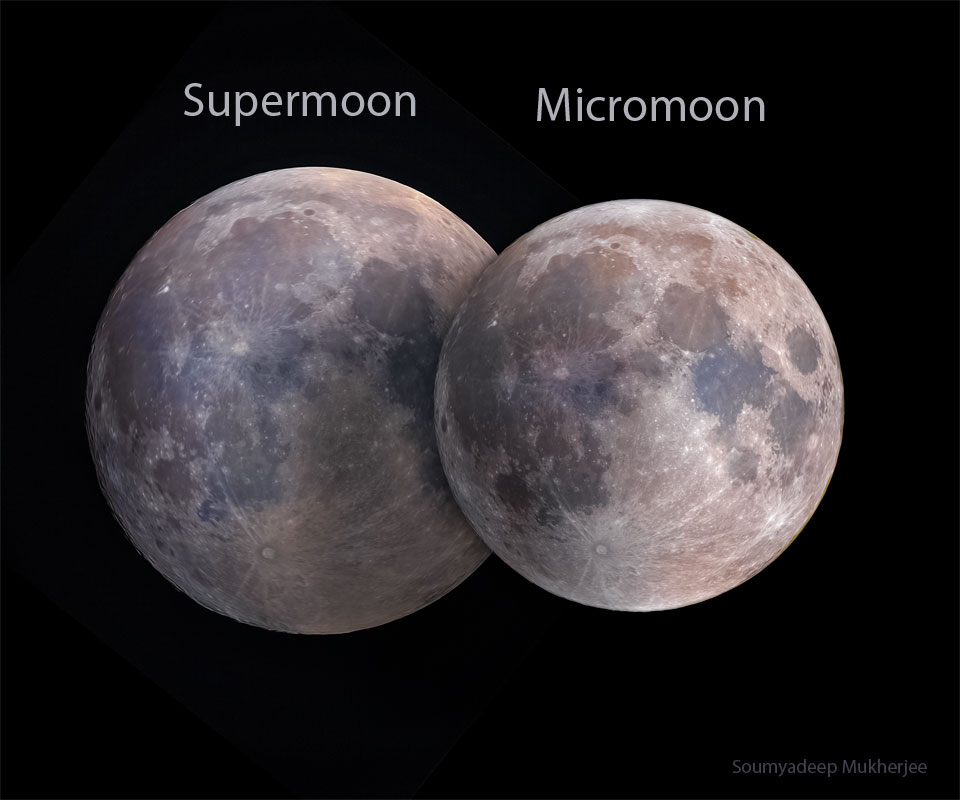
What is so micro about tonight's blue micromoon? Just after sunset, a full moon will appear slightly smaller and dimmer than usual. The reason is that the Moon's fully illuminated phase occurs within a short time of apogee - when the Moon is farthest from the Earth in its elliptical orbit. In fact, tonight's micromoon will be the farthest, smallest, and dimmest Moon this year. But tonight's micromoon is notable for yet another reason: it is also a blue moon, meaning that it is the second full moon in the same month (moon-th). Pictured here, a supermoon -- when the full moon appears near its largest -- is compared to a micromoon as photographed from Kolkata, India in May and December of 2021. Although the next micromoon occurs next month, and the next blue moon at the end of 2028, the next blue micromoon will not occur until 2053.