The Moon
The Moon is Earth’s only natural satellite—a rocky, cratered body about one‑quarter the diameter of Earth, orbiting at an average distance of approximately 384,400 km. It influences tides, stabilizes Earth’s axial tilt, and was formed about 4.5 billion years ago following a collision between Earth and a Mars-sized object.
Source: science.nasa.gov
APODs including "The Moon"
Total Solar Eclipse from Greenland
14/08/2026
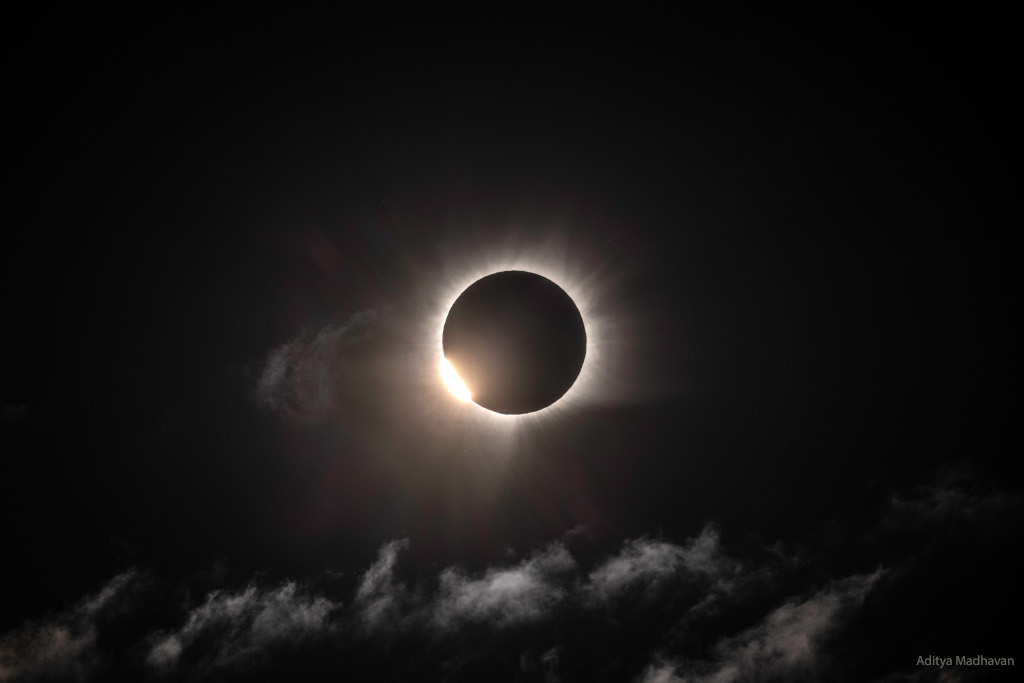
On August 12, the Moon's shadow reached out to touch our fair planet. Beginning in the Arctic Ocean, it swept along a narrow track that led the dark lunar umbra across parts of Greenland, Iceland, the Atlantic, Portugal, and northern Spain. And for a moment, denizens of Earth who found themselves with clear skies under the shadow of the Moon could witness a total solar eclipse. After dodging the weather by sea and making a landing along Rype Fjord on the Greenland east coast (at 71.07055N, 27.71252W), this hard-won snapshot was captured at 17:33:26 UTC. That's near the initial reach of clearing skies along the path of totality, so the image is likely one of the first unobstructed views of the totally eclipsed Sun. Through a break in the clouds, the stunning photo also records one of this eclipse's transient diamond rings and the magnificent solar corona emerging near the moment totality began. More spectacular eclipse images: Solar Eclipse of 2026 August 12