The Sun
The Sun is a yellow dwarf star (G2V), about 4.6 billion years old, and the dominant gravitational force in the Solar System. It has a diameter of roughly 1.4 million kilometers and contains around 99.8% of the Solar System’s mass. Nuclear fusion in its core converts hydrogen into helium, producing energy that warms the planets. Above the core lie the radiative and convective zones, followed by the visible photosphere (~5,500 °C), the chromosphere, and the much hotter corona (~2 million °C).
Source: science.nasa.gov
APODs including "The Sun"
Mercury: Closest Planet to the Sun
14/08/1995
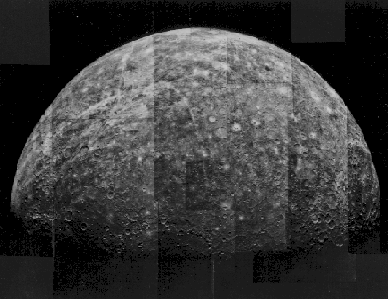
August 14, 1995 Mercury: Closest Planet to the Sun Credit: NASA, Mariner 10 Explanation: This picture was compiled from images taken by the NASA spacecraft Mariner 10 which flew by the planet three times in 1974. Mercury is the closest planet to the Sun, the second hottest planet (Venus gets hotter), and the second smallest planet (Pluto is smaller). Mercury rotates so slowly that one day there - "day" meaning the normal time it takes from sunset to sunset - lasts 176 days on Earth. It is difficult to see Mercury not because it is dim but because it always appears near the Sun, and is therefore only visible for a short time just after sunset or just before sunrise. Mercury is made of rocky material like Earth. No one knows why Mercury has the magnetic field that it does.