The Sun
The Sun is a yellow dwarf star (G2V), about 4.6 billion years old, and the dominant gravitational force in the Solar System. It has a diameter of roughly 1.4 million kilometers and contains around 99.8% of the Solar System’s mass. Nuclear fusion in its core converts hydrogen into helium, producing energy that warms the planets. Above the core lie the radiative and convective zones, followed by the visible photosphere (~5,500 °C), the chromosphere, and the much hotter corona (~2 million °C).
Source: science.nasa.gov
APODs including "The Sun"
Neptune: Big Blue Giant
17/08/1995
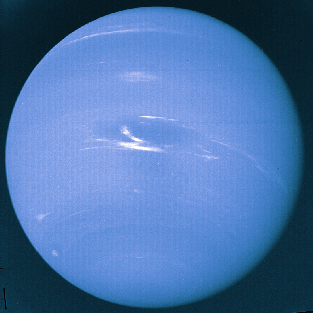
August 17, 1995 Neptune: Big Blue Giant Credit: NASA, Voyager 2, Copyright Calvin J. Hamilton Explanation: This picture was taken by the Voyager 2 spacecraft in 1986 - the only spacecraft ever to visit Neptune. Neptune will be the farthest planet from the Sun until 1999, when the elliptical orbit of Pluto will cause it to once again resume this status. Neptune, like Uranus, is composed mostly of liquid water, methane and ammonia, is surrounded by a thick gas atmosphere of mostly hydrogen and helium, and has many moons and rings. Neptune's moon Triton is unlike any other and has active volcanoes. The nature of Triton's unusual orbit around Neptune is the focus of much discussion and speculation.