The Sun
The Sun is a yellow dwarf star (G2V), about 4.6 billion years old, and the dominant gravitational force in the Solar System. It has a diameter of roughly 1.4 million kilometers and contains around 99.8% of the Solar System’s mass. Nuclear fusion in its core converts hydrogen into helium, producing energy that warms the planets. Above the core lie the radiative and convective zones, followed by the visible photosphere (~5,500 °C), the chromosphere, and the much hotter corona (~2 million °C).
Source: science.nasa.gov
APODs including "The Sun"
Announcing Comet Hale-Bopp
20/08/1995
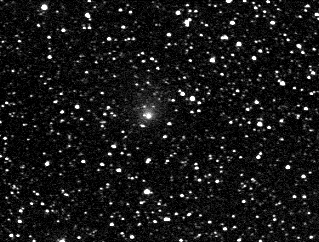
August 20, 1995 Announcing Comet Hale-Bopp Credit: Erich Meyer and Herbert Raab, Austria Explanation: The pictured fuzzy patch may become one of the most spectacular comets this century. Although it is very hard to predict how bright a comet will become, Comet Hale-Bopp, named for its discoverers, was spotted farther from the Sun than any previous comet - a good sign that it could become very bright, easily visible to the naked eye. This picture was taken on July 25th 1995, only two days after its discovery. A comet bright enough to see without a telescope occurs only about once a decade. The large coma and long tail of bright comets are so unusual and impressive that they have been considered omens of change by many cultures. A comet does not streak by in few seconds - but it may change its position and structure noticeably from night to night.