The Sun
The Sun is a yellow dwarf star (G2V), about 4.6 billion years old, and the dominant gravitational force in the Solar System. It has a diameter of roughly 1.4 million kilometers and contains around 99.8% of the Solar System’s mass. Nuclear fusion in its core converts hydrogen into helium, producing energy that warms the planets. Above the core lie the radiative and convective zones, followed by the visible photosphere (~5,500 °C), the chromosphere, and the much hotter corona (~2 million °C).
Source: science.nasa.gov
APODs including "The Sun"
Two Tails of Comet West
26/08/1995
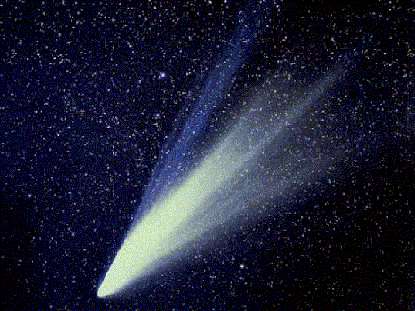
August 26, 1995 Two Tails of Comet West Credit: Observatoire de Haute, Provence, France Explanation: Here Comet West is seen showing two enormous tails that wrap around the sky. The ion tale of a comet usually appears more blue and always points away from the Sun. The dust tail trailing the comet's nucleus is the most prominent. Comet West was a visually spectacular comet, reaching its most picturesque in March of 1976. A comet this bright occurs only about once a decade. Comets are really just large dirty snowballs that shed material when they reach the inner solar-system. Many astronomers are hopeful that Comet Hale-Bopp will look as spectacular as this in the spring of 1997.