The Sun
The Sun is a yellow dwarf star (G2V), about 4.6 billion years old, and the dominant gravitational force in the Solar System. It has a diameter of roughly 1.4 million kilometers and contains around 99.8% of the Solar System’s mass. Nuclear fusion in its core converts hydrogen into helium, producing energy that warms the planets. Above the core lie the radiative and convective zones, followed by the visible photosphere (~5,500 °C), the chromosphere, and the much hotter corona (~2 million °C).
Source: science.nasa.gov
APODs including "The Sun"
Earth's Moon, A Familiar Face
03/09/1995
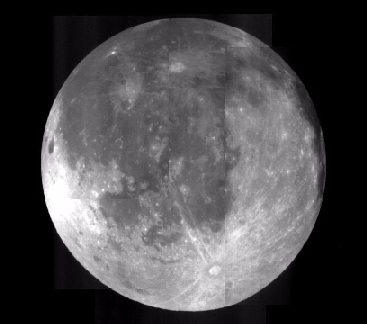
The above mosaic of the Earth's Moon was compiled from photos taken by the spacecraft Clementine in 1994. This image represents the side of the Moon familiar to Earth dwellers. The Moon revolves around the Earth about once every 28 days. Since its rate of rotation about its axis is also once in 28 days, it always keeps the same face toward the Earth. As the Moon travels around its orbit, the Earth based view of the half of the Moon that faces the Sun changes causing the regular monthly progression of Lunar phases. Humans first crashed a spacecraft into the Moon in 1959, but the first humans to reach the Moon landed in 1969. There are now golf balls on the Moon.