The Sun
The Sun is a yellow dwarf star (G2V), about 4.6 billion years old, and the dominant gravitational force in the Solar System. It has a diameter of roughly 1.4 million kilometers and contains around 99.8% of the Solar System’s mass. Nuclear fusion in its core converts hydrogen into helium, producing energy that warms the planets. Above the core lie the radiative and convective zones, followed by the visible photosphere (~5,500 °C), the chromosphere, and the much hotter corona (~2 million °C).
Source: science.nasa.gov
APODs including "The Sun"
A Total Solar Eclipse
24/10/1995
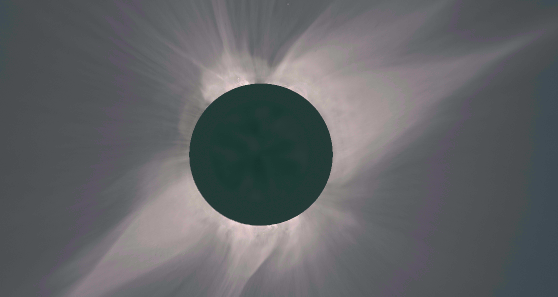
Pictured above is a total solar eclipse, with the Sun's corona, clearly visible surrounding the Moon. This picture is a composite of differently exposed photos of an eclipse that occurred on July 11, 1991. Today there will be another total eclipse of the Sun, the last until March 1997. The path of today's total eclipse will begin in the Middle East, move though southern China, and end in the Pacific Ocean south of the Marshall Islands. Those only near the path will see a partial solar eclipse. NASA keeps detailed maps of the predicted path of the eclipse.