The Sun
The Sun is a yellow dwarf star (G2V), about 4.6 billion years old, and the dominant gravitational force in the Solar System. It has a diameter of roughly 1.4 million kilometers and contains around 99.8% of the Solar System’s mass. Nuclear fusion in its core converts hydrogen into helium, producing energy that warms the planets. Above the core lie the radiative and convective zones, followed by the visible photosphere (~5,500 °C), the chromosphere, and the much hotter corona (~2 million °C).
Source: science.nasa.gov
APODs including "The Sun"
Releasing Compton
29/11/1995
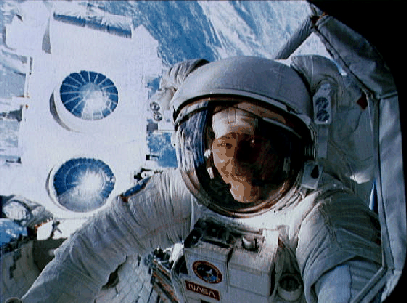
Named for Nobel laureate physicist Arthur Holly Compton, the Compton Gamma Ray Observatory (CGRO) Satellite was launched in April of 1991 aboard the Space Shuttle Atlantis. CGRO's mission is to explore the Universe at gamma-ray energies. The massive space based observatory is seen here held upright in the shuttle payload bay behind smiling astronaut Jerry Ross. Ross and his colleague Jay Apt have just finished a successful, unplanned spacewalk to free a jammed antenna prior to releasing CGRO into orbit. CGRO has been operating successfully since, providing the first all-sky survey at gamma-ray energies along with exciting new observations of the sun, quasars, pulsars, supernova, black holes, and gamma-ray bursts.