The Sun
The Sun is a yellow dwarf star (G2V), about 4.6 billion years old, and the dominant gravitational force in the Solar System. It has a diameter of roughly 1.4 million kilometers and contains around 99.8% of the Solar System’s mass. Nuclear fusion in its core converts hydrogen into helium, producing energy that warms the planets. Above the core lie the radiative and convective zones, followed by the visible photosphere (~5,500 °C), the chromosphere, and the much hotter corona (~2 million °C).
Source: science.nasa.gov
APODs including "The Sun"
NGC 2440 Nucleus: The Hottest Star?
30/11/1995
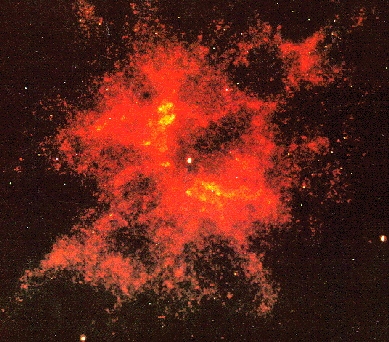
In the center of the above photograph lies a star with one of the hottest surface temperatures yet confirmed. This bright white dwarf star's surface has been measured at greater than 200,000 degrees Celsius - more than 30 times hotter than that of our own Sun. The white dwarf's extreme heat makes it glow extraordinarily bright: intrinsically more than 250 times brighter than the Sun. The star is at the center of the planetary nebula titled NGC 2440, which lies inside our Milky Way Galaxy. The above computer sharpened image was taken by the Hubble Space Telescope.