The Sun
The Sun is a yellow dwarf star (G2V), about 4.6 billion years old, and the dominant gravitational force in the Solar System. It has a diameter of roughly 1.4 million kilometers and contains around 99.8% of the Solar System’s mass. Nuclear fusion in its core converts hydrogen into helium, producing energy that warms the planets. Above the core lie the radiative and convective zones, followed by the visible photosphere (~5,500 °C), the chromosphere, and the much hotter corona (~2 million °C).
Source: science.nasa.gov
APODs including "The Sun"
An Atlas Centaur Rocket Launches
14/12/1995
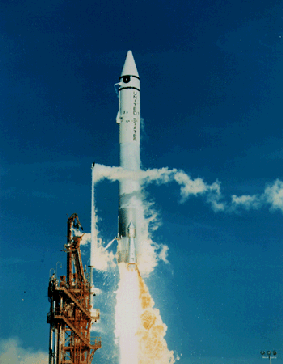
Atlas Centaur rockets have launched over 75 successful unmanned missions. These missions included the Surveyor series - the first vehicles to make soft landings on the Moon, Pioneer 10 and 11 - the first missions to fly by Jupiter and Saturn and the first man-made objects able to leave our Solar System, the Viking missions which landed on Mars, several satellites in the High Energy Astrophysics Observatory (HEAO) series, Pioneer Venus which circled and mapped the surface of Venus, and numerous Intelsat satellites. Of recent scientific interest was the Atlas launched SOHO mission which will continually observe the Sun. Atlas rockets are manufactured by Lockheed Martin Co.