The Sun
The Sun is a yellow dwarf star (G2V), about 4.6 billion years old, and the dominant gravitational force in the Solar System. It has a diameter of roughly 1.4 million kilometers and contains around 99.8% of the Solar System’s mass. Nuclear fusion in its core converts hydrogen into helium, producing energy that warms the planets. Above the core lie the radiative and convective zones, followed by the visible photosphere (~5,500 °C), the chromosphere, and the much hotter corona (~2 million °C).
Source: science.nasa.gov
APODs including "The Sun"
Mercury's Caloris Basin
20/01/1996
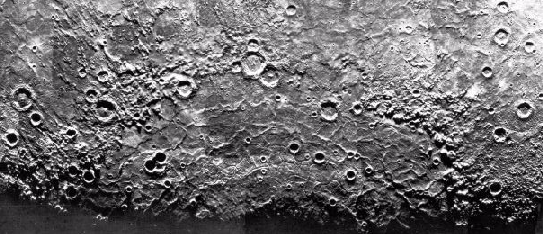
Mercury, the closest planet to the Sun, has a surface with so many craters it resembles the Earth's Moon. The largest surface feature on Mercury is the Caloris Basin, which resulted from a collision with an asteroid. The basin, which is more that 1000 kilometers across, is visible as the large circular feature at the bottom of the above photograph. Similar features, such as the Mare Orientale, are seen on the Moon. The Caloris Basin gets very hot because it is near the "sub-solar point" - the point on Mercury's surface that is directly under the Sun when Mercury is closest to the Sun.