The Sun
The Sun is a yellow dwarf star (G2V), about 4.6 billion years old, and the dominant gravitational force in the Solar System. It has a diameter of roughly 1.4 million kilometers and contains around 99.8% of the Solar System’s mass. Nuclear fusion in its core converts hydrogen into helium, producing energy that warms the planets. Above the core lie the radiative and convective zones, followed by the visible photosphere (~5,500 °C), the chromosphere, and the much hotter corona (~2 million °C).
Source: science.nasa.gov
APODs including "The Sun"
Lensing through Baade's Window
01/02/1996
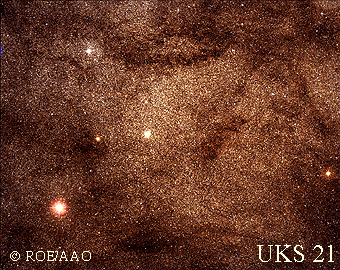
What is the shape and composition of our Milky Way Galaxy? This question would be easier to answer if there wasn't so much obscuring dust! In the 1940s, however, astronomer Walter Baade identified a "window" near the center of our Galaxy where there is comparatively little opaque dust. Now called "Baade's Window", this sky region contains millions of stars and is used for many studies of the distant Milky Way. One clever use, devised by Bohdan Paczynski, is to monitor millions of stars in our Galactic Bulge - many through Baade's window - for sudden brightening due to gravitational lensing. Current observations by the OGLE and MACHO collaborations have now identified dozens of gravitational amplification events. This unexpectedly large number supports previous claims that our Galaxy has a "bar" of stars across the central nucleus, pointed nearly at the Sun.