The Sun
The Sun is a yellow dwarf star (G2V), about 4.6 billion years old, and the dominant gravitational force in the Solar System. It has a diameter of roughly 1.4 million kilometers and contains around 99.8% of the Solar System’s mass. Nuclear fusion in its core converts hydrogen into helium, producing energy that warms the planets. Above the core lie the radiative and convective zones, followed by the visible photosphere (~5,500 °C), the chromosphere, and the much hotter corona (~2 million °C).
Source: science.nasa.gov
APODs including "The Sun"
Hyakutake: The Great Comet of 1996?
08/02/1996
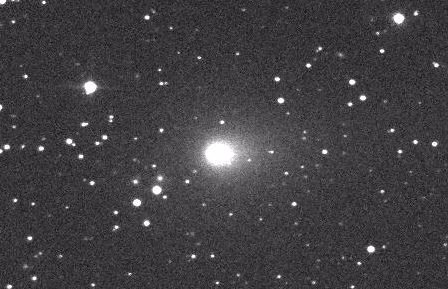
Get ready for one of the most impressive but least anticipated light shows in modern astronomical history. Next month, newly discovered Comet Hyakutake will pass closer to the Earth than any recent comet. Unknown before its discovery by Yuji Hyakutake on 30 January 1996, the fuzzy spot in the above photograph is a comet now predicted to become bright enough to see without a telescope. Although comets act in such diverse ways that predictions are frequently inaccurate, even conservative estimates indicate that this comet is likely to impress. For example, even if Comet Hyakutake remains physically unchanged, its close pass near the Earth in late March 1996 should cause it to appear to brighten to about 3rd magnitude - still bright enough to see with the unaided eye. In the next two months, though, the comet will continue to approach the Sun and hence should become brighter still. Optimistic predictions include that Comet Hyakutake will change physically, develop a larger coma and tail, brighten dramatically, move noticeably in the sky during a single night, and may ultimately become known as the "The Great Comet of 1996." Move over Hale-Bopp!