The Sun
The Sun is a yellow dwarf star (G2V), about 4.6 billion years old, and the dominant gravitational force in the Solar System. It has a diameter of roughly 1.4 million kilometers and contains around 99.8% of the Solar System’s mass. Nuclear fusion in its core converts hydrogen into helium, producing energy that warms the planets. Above the core lie the radiative and convective zones, followed by the visible photosphere (~5,500 °C), the chromosphere, and the much hotter corona (~2 million °C).
Source: science.nasa.gov
APODs including "The Sun"
The McMath-Pierce Solar Observatory
15/03/1996
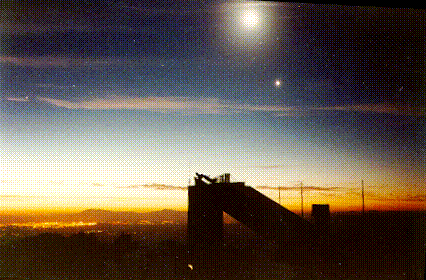
This odd-looking structure silhouetted in the foreground houses the three largest solar telescopes in the world. Located in Kitt Peak, Arizona, the largest telescope inside the McMath-Pierce Facility is 1.6-meters in diameter and contains only mirrors. The telescope contains no windows or lenses because focusing bright sunlight would overheat them. Visible in the background of this sunrise photo are the Moon and Venus. The telescopes are used in many research projects including determining the Sun's structure, researching the cause of the solar corona, monitoring Sun-spots and solar flares, and observing bright planets and comets near the Sun. The telescopes even help monitor the Earth's atmospheric content of ozone and CFCs! Information: The Scale of the Universe Debate in April 1996