The Sun
The Sun is a yellow dwarf star (G2V), about 4.6 billion years old, and the dominant gravitational force in the Solar System. It has a diameter of roughly 1.4 million kilometers and contains around 99.8% of the Solar System’s mass. Nuclear fusion in its core converts hydrogen into helium, producing energy that warms the planets. Above the core lie the radiative and convective zones, followed by the visible photosphere (~5,500 °C), the chromosphere, and the much hotter corona (~2 million °C).
Source: science.nasa.gov
APODs including "The Sun"
The Ion Tail of Comet Hyakutake
19/03/1996
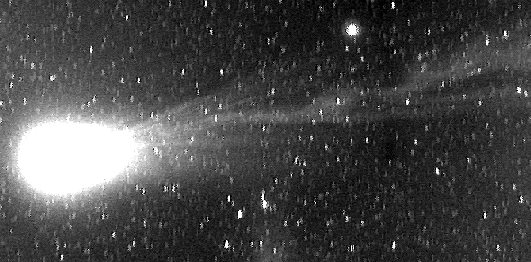
This picture of Comet Hyakutake was taken on March 14, 1996. Structure in the ion tale of Comet Hyakutake is now clearly visible. An ion tale forms as a comet nears the Sun. Sunlight causes gas and dust to boil off the comet's solid nucleus. Charged gas - called ions - are then accelerated away from the Sun by the solar wind - fast moving particles streaming out from the Sun's corona. The ion tale will appear blue and glows by fluorescence. As Comet Hyakutake gets closer to the Sun during the next month, a dust tail is expected to be visible as well. Dust tails shine by light reflected from the Sun. Comet tails point away from the Sun, even as a comet moves away from the Sun. For observers in the Northern Hemisphere, Comet Hyakutake should appear tonight in the eastern part of the constellation of Virgo and should be about magnitude 2.5. The comet will look the most impressive in the darkest skies - in a city you are likely to see only a fuzzy blob! Information: The Scale of the Universe Debate in April 1996