The Sun
The Sun is a yellow dwarf star (G2V), about 4.6 billion years old, and the dominant gravitational force in the Solar System. It has a diameter of roughly 1.4 million kilometers and contains around 99.8% of the Solar System’s mass. Nuclear fusion in its core converts hydrogen into helium, producing energy that warms the planets. Above the core lie the radiative and convective zones, followed by the visible photosphere (~5,500 °C), the chromosphere, and the much hotter corona (~2 million °C).
Source: science.nasa.gov
APODs including "The Sun"
Comet Hyakutake and a Tree
10/04/1996
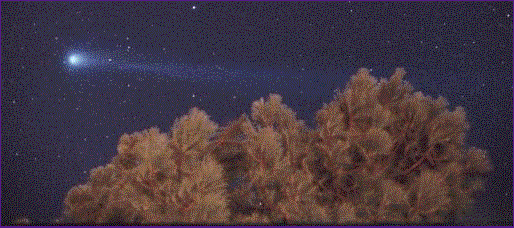
Comet Hyakutake is still visible as it continues its orbit around the Sun. The comet will brighten again in late April and early May. The above fascinating picture was taken with a three minute exposure. In the middle of the exposure, the photographer cleverly set off a flash, momentarily illuminating the foreground tree. The picture was taken on March 24th from Mount Teide in the Canary Islands, and the recorded tail length was over 50 degrees. Discoverer Yuji Hyakutake, whose last name means "100 warriors" is an amateur astronomer in Japan. Interested in comets since age 15, he discovered this comet while sitting on a rural mountain top searching dark skies with huge binoculars in early morning hours. Originally intending to check up on a comet he had discovered only one month earlier, Hyakutake was initially worried that the new fuzzy spot he had located was not really yet another comet! One unexpected result of his comet discovery is that now his family has trouble making phone calls because their telephone is always ringing. Information: The Scale of the Universe Debate in April 1996