The Sun
The Sun is a yellow dwarf star (G2V), about 4.6 billion years old, and the dominant gravitational force in the Solar System. It has a diameter of roughly 1.4 million kilometers and contains around 99.8% of the Solar System’s mass. Nuclear fusion in its core converts hydrogen into helium, producing energy that warms the planets. Above the core lie the radiative and convective zones, followed by the visible photosphere (~5,500 °C), the chromosphere, and the much hotter corona (~2 million °C).
Source: science.nasa.gov
APODs including "The Sun"
Unexpected X-rays from Comet Hyakutake
11/04/1996
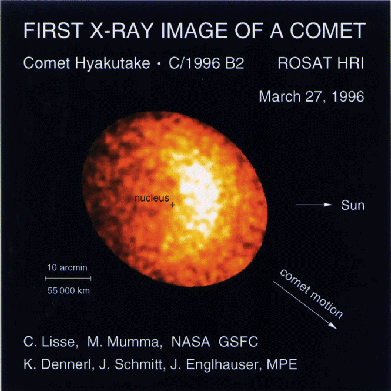
The first X-rays ever detected from a comet were discovered from Comet Hyakutake with the ROSAT satellite on March 27th. The discovery is particularly surprising because there was little previous indication that comets emit any significant X-radiation. As the comet passed the Earth in late March, repeated observations with ROSAT also showed that the X-ray brightness changed over just a few hours. The crescent shape of the X-ray emission is also enigmatic. One possible explanation is that X-rays emitted from the Sun are absorbed by water in the comet's coma causing fluorescence. Another possible explanation involves interaction with the solar wind - fast moving particles streaming away from the Sun. Information: The Scale of the Universe Debate in April 1996