The Sun
The Sun is a yellow dwarf star (G2V), about 4.6 billion years old, and the dominant gravitational force in the Solar System. It has a diameter of roughly 1.4 million kilometers and contains around 99.8% of the Solar System’s mass. Nuclear fusion in its core converts hydrogen into helium, producing energy that warms the planets. Above the core lie the radiative and convective zones, followed by the visible photosphere (~5,500 °C), the chromosphere, and the much hotter corona (~2 million °C).
Source: science.nasa.gov
APODs including "The Sun"
Hyakutake, Venus, Orion, and Pond
18/04/1996
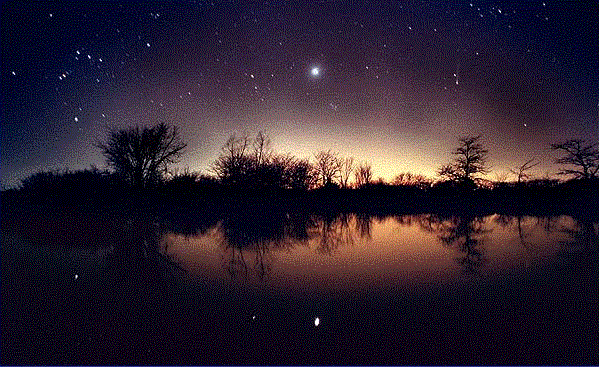
Can you find Comet Hyakutake in the above picture? In this gorgeous photo, the starry night sky of April 9th is pictured with its new comet visitor. In the foreground is a pond with the lights of Kansas City, Missouri on the western horizon. On the upper left, the constellation of Orion is visible. At the center, the brightest object in the picture is the planet Venus. Venus's reflection can be seen in the pond. On the right - halfway between Venus and the photograph's edge - can be seen two bright objects fairly close to each other. Of these two, look closely at lower right object. See the tail? Comet Hyakutake is still visible for Northern observers in the Western sky and now has begun to brighten again as it nears the Sun. Latest Comet Hyakutake images: APOD Hyakutake Archive, JPL, Fayetteville Observer-Times, NASA's Night of the Comet, ICSTARS, Jerry Lodriguss, ScienceWeb, Crni Vrh Obs.,