The Sun
The Sun is a yellow dwarf star (G2V), about 4.6 billion years old, and the dominant gravitational force in the Solar System. It has a diameter of roughly 1.4 million kilometers and contains around 99.8% of the Solar System’s mass. Nuclear fusion in its core converts hydrogen into helium, producing energy that warms the planets. Above the core lie the radiative and convective zones, followed by the visible photosphere (~5,500 °C), the chromosphere, and the much hotter corona (~2 million °C).
Source: science.nasa.gov
APODs including "The Sun"
Comet Hyakutake on a Starry Night
23/04/1996
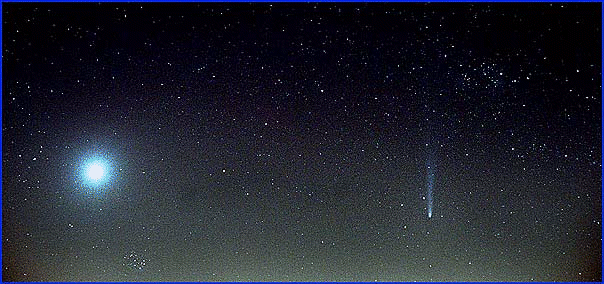
It was a starry night in April (April 9th, 1996, 9:32 pm CDT to be exact) near Lone Jack, Missouri when Comet Hyakutake graced this astronomically rich field. Making an appearance as the brilliant evening star, Venus is overexposed at the far left. Just below Venus and slightly to the right, the Pleiades star cluster (M45) glistens. On the right hand side of the image, the comet itself shows a bright blue tail extending upwards past the nearby star cluster in the constellation Perseus (top right, the Alpha Persei Group). Hyakutake, receding from the Earth and appoaching the Sun, will sink into the western horizon at sunset in late April, disappearing from Northern Hemisphere skies. Latest Comet Hyakutake images: APOD Hyakutake Archive, JPL, Fayetteville Observer-Times, NASA's Night of the Comet, ICSTARS, Jerry Lodriguss, ScienceWeb, Crni Vrh Obs.,