The Sun
The Sun is a yellow dwarf star (G2V), about 4.6 billion years old, and the dominant gravitational force in the Solar System. It has a diameter of roughly 1.4 million kilometers and contains around 99.8% of the Solar System’s mass. Nuclear fusion in its core converts hydrogen into helium, producing energy that warms the planets. Above the core lie the radiative and convective zones, followed by the visible photosphere (~5,500 °C), the chromosphere, and the much hotter corona (~2 million °C).
Source: science.nasa.gov
APODs including "The Sun"
Comet Hyakutake and a Cactus
01/05/1996
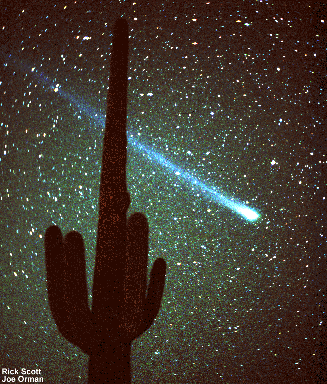
Comet Hyakutake is shown photographed the night of March 27 in Arizona, USA, with a cactus in the foreground. Polaris, the north star, is the bright star seen just to the upper right of the comet's head. Today Comet Hyakutake reaches its closest approach to the Sun. Comet Hyakutake is now at its intrinsic brightest, but because of its distance from the Earth, it will appear less bright to us than it did during its closest approach to the Earth in late March. In fact, due to the comet's angular proximity to the Sun, it will difficult to see at all from the Earth! Comet Hyakutake will reach less than one quarter of the Earth-Sun distance - inside the orbit of Mercury. Comet Hyakutake will not venture near the Sun again for another about 15,000 years. Latest Comet Hyakutake images: APOD Hyakutake Archive, JPL, Fayetteville Observer-Times, NASA's Night of the Comet, ICSTARS, Jerry Lodriguss, ScienceWeb, Crni Vrh Obs.,