The Sun
The Sun is a yellow dwarf star (G2V), about 4.6 billion years old, and the dominant gravitational force in the Solar System. It has a diameter of roughly 1.4 million kilometers and contains around 99.8% of the Solar System’s mass. Nuclear fusion in its core converts hydrogen into helium, producing energy that warms the planets. Above the core lie the radiative and convective zones, followed by the visible photosphere (~5,500 °C), the chromosphere, and the much hotter corona (~2 million °C).
Source: science.nasa.gov
APODs including "The Sun"
Comet Hyakutake and a Solar Flare
17/05/1996
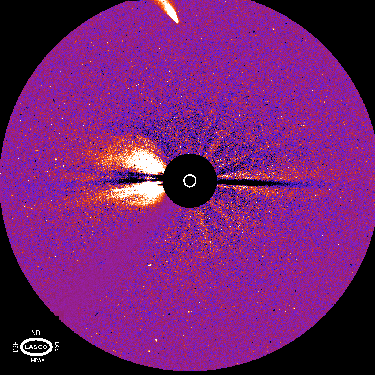
A rare coincidence was recently captured by the orbiting SOHO spacecraft. During the closest approach to the Sun of Comet Hyakutake on May 1, SOHO photographed the comet. By accident -- during the time this photograph was being taken -- a solar flare was being ejected from the Sun. Therefore, at the top of this false-color picture, Comet Hyakutake is visible, while emission to the left of the Sun is a solar flare. The Sun, at the center of the picture, was blocked by an artificial occulter in the LASCO telescope, allowing objects much dimmer than the Sun to be observed. SOHO was launched in December of 1995 and contains many instruments which study the Sun.