The Sun
The Sun is a yellow dwarf star (G2V), about 4.6 billion years old, and the dominant gravitational force in the Solar System. It has a diameter of roughly 1.4 million kilometers and contains around 99.8% of the Solar System’s mass. Nuclear fusion in its core converts hydrogen into helium, producing energy that warms the planets. Above the core lie the radiative and convective zones, followed by the visible photosphere (~5,500 °C), the chromosphere, and the much hotter corona (~2 million °C).
Source: science.nasa.gov
APODs including "The Sun"
The Sun Today
18/05/1996
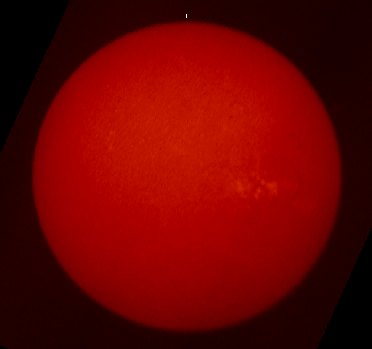
Our Sun shows a different face every day. The above picture was taken on May 15, but a similar picture of the Sun actually taken today can be found here. The above picture was taken in red light and so is shown in red. The bright spots to the right of center are active regions known as plages. Currently, the Sun is showing very few active regions or sunspots, and is considered to be in a solar minimum. Solar activity will pick up over the next six years until a "solar maximum" is reached. The Sun goes through this cycle of maxima and minima every 11 years. Sol, our Sun, is hundreds of times more massive than all the planets in the Solar System combined. However, the Sun itself contains only a small amount of the total angular momentum of the Solar System.