The Sun
The Sun is a yellow dwarf star (G2V), about 4.6 billion years old, and the dominant gravitational force in the Solar System. It has a diameter of roughly 1.4 million kilometers and contains around 99.8% of the Solar System’s mass. Nuclear fusion in its core converts hydrogen into helium, producing energy that warms the planets. Above the core lie the radiative and convective zones, followed by the visible photosphere (~5,500 °C), the chromosphere, and the much hotter corona (~2 million °C).
Source: science.nasa.gov
APODs including "The Sun"
Helios Helium
20/05/1996
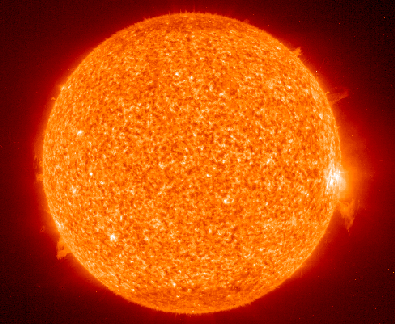
Above is an image of the relatively quiet Sun made on May 18 in light emitted by ionized Helium atoms in the Solar chromosphere. Helium was first discovered in the Sun in 1868, its name fittingly derived from from the Greek word Helios, meaning Sun. Credit for the discovery goes to astronomer Joseph Lockyer. Lockyer relied on a recently developed technique of spectroscopy, dissecting sunlight into a spectrum, and the idea that each element produces a characteristic spectral pattern of bright lines. He noticed a yellow line in a solar spectrum made during an eclipse which could not be accounted for by elements known on Earth. Almost 27 years later Helium was finally discovered on Earth when the spectrum of a Helium bearing mineral of Uranium provided an exact match to the previously detected element of the Sun. Helium is now known to be the second most abundant element (after Hydrogen) in the Universe.