The Sun
The Sun is a yellow dwarf star (G2V), about 4.6 billion years old, and the dominant gravitational force in the Solar System. It has a diameter of roughly 1.4 million kilometers and contains around 99.8% of the Solar System’s mass. Nuclear fusion in its core converts hydrogen into helium, producing energy that warms the planets. Above the core lie the radiative and convective zones, followed by the visible photosphere (~5,500 °C), the chromosphere, and the much hotter corona (~2 million °C).
Source: science.nasa.gov
APODs including "The Sun"
The Iron Sun
21/05/1996
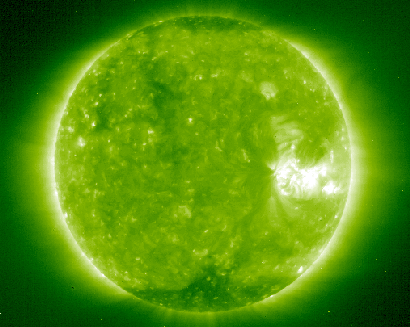
The ultraviolet light emitted by eleven times ionized iron at temperatures over 2 million degrees Farenheit was used to record the above picture of the Sun on May 16. The image was made by the EIT camera onboard the SOHO spacecraft, a space observatory which can continuously observe the Sun. Eleven times ionized iron is atomic iron with eleven of its electrons stripped away. Here the electrons are stripped by the frantic collisions with other atoms and electrons which occur at the extreme temperatures in the Solar Corona. Since electrons are negatively charged, the resulting ionized iron atom is highly positively charged. Astronomer's "shorthand" for eleven times ionized iron is written "Fe XII", the chemical symbol for iron followed by a Roman numeral 12 (Fe I is neutral iron).